Grubby AI Humanizer Review
Grubby AI sells the boldest commercial promise in the humanizer category, a money-back guarantee tied to bypassing Turnitin, on top of a free tier capped at 300 words per input and three plans from $12.99 a month. This review judges it for academic work, where what matters is whether your citations survive, and a refund policy says nothing about that.
Grubby AI is an AI humanizer built around one promise: a money-back guarantee tied to bypassing Turnitin. That guarantee is a refund policy. It describes what happens to your money if a pass fails, and says nothing about the state of your citations after the rewrite.
The structure around it is simple: a free tier capped at 300 words per input, then Essential at $12.99 a month for 10,000 humanizer words, Pro at $15.99 for 30,000 words, and Unlimited at $22.99 with larger input limits for heavy use. This review judges Grubby AI for academic work: theses, manuscripts and coursework, where the reference list gets checked as closely as the prose.
What Universities Actually Allow
Disclosure is the rule at most institutions, and outright prohibition is rare. COPE's position on authorship and AI tools reaches that conclusion from the ethics side: a tool cannot take responsibility for the work, so a human author must, and must state what the tool did. Nothing in it forbids using a model in the writing process.
Elsevier's generative AI policy lands in the same place for manuscripts, permitting these tools to improve readability and language provided the paper carries a declaration. Universities apply the logic to coursework. The breach is undeclared use, and a reference that no longer matches the source you read is a separate problem that no disclosure statement covers. Our AI disclosure statement template covers the wording most departments expect.
Why AI Drafts Need Humanizing
Raw model prose is generic in a way readers notice before they can name it: sentences of uniform length, connectives collapsed into the same few joins, hedges stacked until a claim commits to nothing. Our list of AI words and phrases shows how small the working vocabulary is.
The second problem is measurement. Turnitin, GPTZero, Originality.ai and Pangram do not read for meaning. They score how predictable each token is against what a language model would have chosen next, and generated prose scores as highly predictable. Our guide to how AI detectors work sets out the measurement. No humanizer can promise a detector outcome on a specific document.
How AI Humanizers Work
- Varying sentence structure. This moves detector scores the most, because sentence-length variance is measured directly. Breaking a run of even twenty-word sentences into a mix of short and long changes the statistical shape of a passage as well as its wording.
- Substituting model-typical vocabulary. Second in effect. On its own it changes texture and leaves structure where it was.
- Adjusting register. Third, and the place general tools go wrong for academic users. Most aim at conversational output, which is the wrong target for a methods chapter.
What Grubby AI Is and How It Works
Grubby AI is a paste-in rewriter with a deliberately small surface. There is an input box, a word limit set by your plan, and output. The free tier caps input at 300 words, and that cap shapes everything else about the tool.
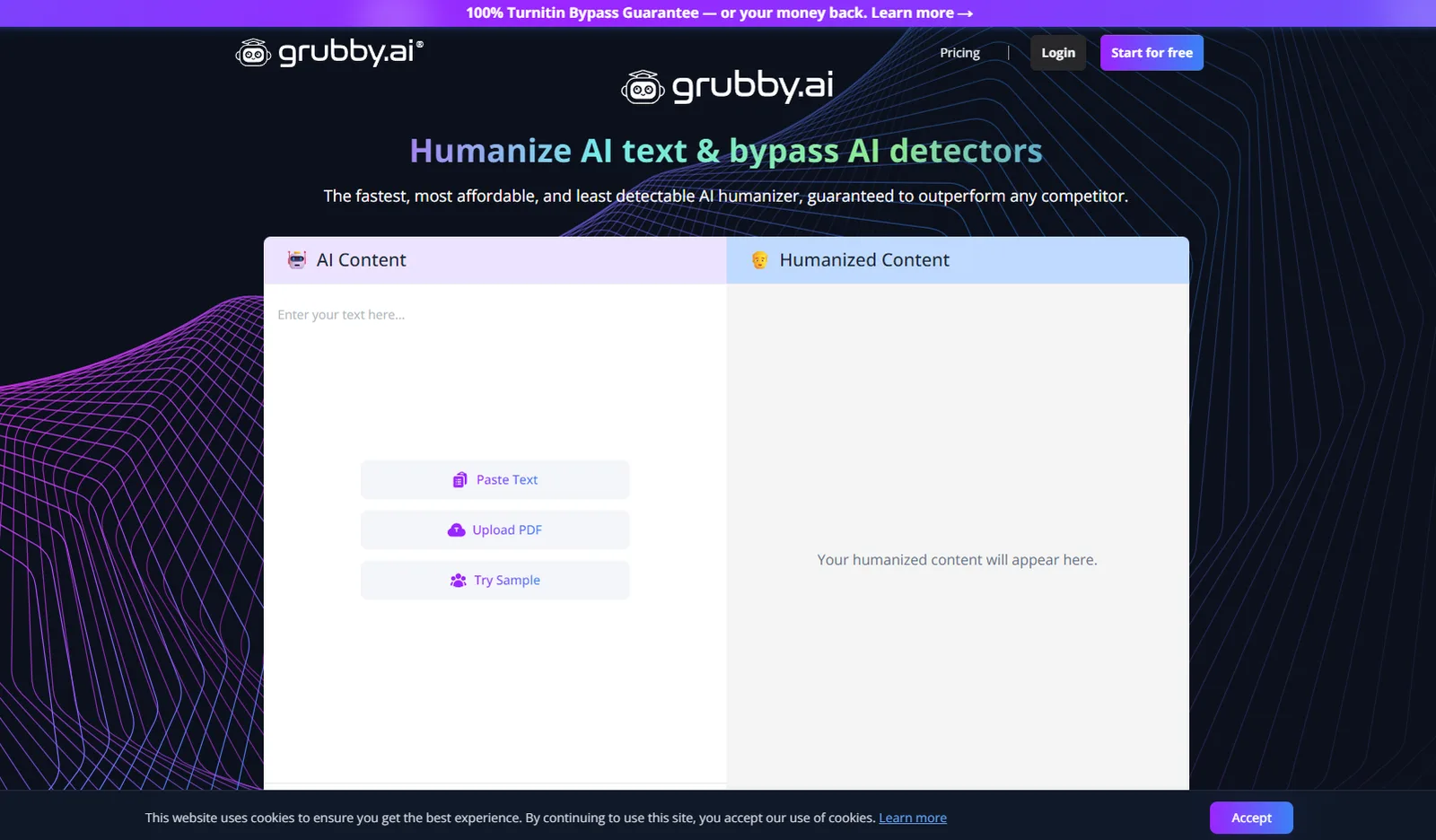
Reviewers place it as effective on short passages and quick edits, with consistency dropping on longer pieces. The cause is simple: a rewriter working on a few hundred words holds the whole passage in view, so its choices stay consistent with each other. Extend the same engine over several thousand words and the choices stop agreeing: a term rendered one way in the introduction comes back another way in the discussion, and register drifts between sections you wrote in one voice.
For a paragraph that needs loosening, that is a small problem. For a chapter assessed as a single document, the seams are visible to a reader even when every individual sentence is defensible, which makes Grubby AI better suited to minor tasks than to publication-ready material.
The Money-Back Bypass Guarantee
The guarantee is the reason most people try this tool. If output does not clear the detector named in the terms, you are refunded. That costs the vendor money when it fires, and a company willing to attach a refund to an outcome has more confidence in its engine than one that says nothing at all. For a buyer choosing between similar-looking products, that is a genuine signal.
A refund is not evidence, though. It tells you nothing about the pass rate across a set of documents. It arrives after the fact, when the submission has already happened, and it restores no mark, no resubmission window and no supervisor's confidence.
It also says nothing about the thing academic users most need checked: whether the rewrite altered a surname, dropped a page number, renamed an instrument or restructured a reported figure. Text can clear a detector and still be wrong in ways that cost more than the subscription did.
Then there is the question of which detector. A guarantee tied to Turnitin covers one system's verdict at one moment. A Vrije Universiteit Brussel study in the International Journal for Educational Integrity ran 160 academic papers of over 4,000 words through four detectors and found results that diverged sharply: Pangram flagged 97.5% of fully AI-generated papers and 92.5% of humanized ones, while Turnitin flagged 0% of the fully AI-generated set and 50% of the humanized set. All four cleared 100% of the human-written papers. Clearing one detector says little about the field, and the detector your department runs next year may differ from the one named in the terms you accept now.
Humanize your own paper
Transform your AI-assisted text and make it sound human, without touching important words or citations.
Grubby AI Pricing and Plans
Pricing is straightforward, which counts for something in a category fond of complicated credit systems.
| Plan | Price | Allowance |
|---|---|---|
| Free | No cost | 300 words per input |
| Essential | $12.99 a month | 10,000 humanizer words |
| Pro | $15.99 a month | 30,000 humanizer words |
| Unlimited | $22.99 a month | Larger input limits for heavy use |
The 300-word free input is the real limitation. It is enough to see whether output reads naturally, but not enough to judge quality on a real section of academic work. A methods section is longer than that. So is a literature review paragraph with three citations in it, once the citations are counted. The free tier tests the easy case, short and self-contained, which is the case this tool already handles well.
If you do test it, spend those 300 words on a passage that resembles your actual work, parentheticals left in and technical vocabulary intact. A clean sample only confirms that the output is fluent.
Citations, Terminology, Statistics and Register
Grubby AI has no citation handling and no terminology lock, and citations are where that shows first.
Citations
To a rewriter with no citation rule, a parenthetical like (Halvorsen and Aoki, 2020, p. 42) is ordinary prose, as open to improvement as any other string. The surname shifts by a letter. The parenthetical folds into the sentence as narrative attribution. The page number vanishes because it did nothing for the rhythm. Each edit produces plausible text, and each one breaks a link a marker checks in seconds against your reference list. Our piece on whether Turnitin can detect paraphrased text covers what happens downstream.
Terminology and statistics
With no term lock available, a rewriter hunting for variation treats a validated instrument name as a synonym opportunity, and "randomly assigned" becomes "randomly distributed", a different claim about your method. Numbers carry the same problem: effect sizes, intervals and formulas sit inside sentences the rewriter may restructure, and a wrong figure reads as fluently as a right one. Over a long document that drift compounds.
Register
Casual output suits a forum post but not a literature review. A tool that lowers the reading level to sound more human moves your writing away from the Flesch-Kincaid grade 13 to 18 band an examiner expects, and Grubby AI leans casual by design.
How It Scored in Our Testing
Turnitin results were the tool's best area by a distance, consistent with reviewers who find it effective on short passages. The engine does move text off the predictable patterns detectors score. Grammar sat below the middle of the field, so output needs correcting before it goes anywhere near a supervisor.
Citations were the weakest area of all, and the one that decides this review. Parentheticals and reference entries are ordinary rewritable text here. Key terms follow: with no way to freeze a construct or instrument name before the pass, controlled vocabulary drifts toward its nearest synonym, and over a chapter that drift accumulates into inconsistency a reader in the field will notice.
Academic tone leaned casual, which suits the short-form work the tool is aimed at and undercuts a submitted chapter. The dashboard is simple and quick to learn, with almost nothing to configure. Language coverage is adequate rather than a strength.
Grubby AI Alternatives
- Undetectable AI. General content at volume, sold as monthly word pools, with a refund if output is flagged. It produced the strongest Turnitin results of any humanizer we ran.
- QuillBot Humanizer. Sits inside the QuillBot paraphrase suite, so it costs nothing extra if you already pay for that.
- StealthGPT. Built for SEO and copywriting at scale.
- Phrasly. Pairs a humanizer with a document editor, for people who draft and rewrite in one session.
All four are general content designs, so none of them changes the academic answer. For theses and manuscripts, where citations, locked terminology and register all have to survive the rewrite, use TextPulse. The wider field is compared in our guide to the best AI humanizer.
TextPulse vs Grubby AI
| Comparison | TextPulse | Grubby AI |
|---|---|---|
| Built for | Academic documents: theses, manuscripts, coursework | Casual short-form rewriting and quick edits |
| Citation handling | Citations and reference entries preserved verbatim in APA, MLA, IEEE, Chicago, Harvard and Vancouver | None described |
| Terminology control | Freeze Terms locks any construct or instrument name before the rewrite | None described |
| Register | Peer-reviewed training data, held at Flesch-Kincaid grade 13 to 18 | Output leans casual, no stated band |
| Long documents | Processed whole, so terminology does not drift between sections | Effective on short passages, consistency drops on longer pieces |
| Published detector evidence | Vendor benchmark on a 2,000 document academic corpus: 92.33% Turnitin AI, 89.12% Originality.ai, 87.91% GPTZero | A money-back guarantee in place of a measured pass rate |
| Price | Pro $19 a month for 25,000 words, Plus $29 for 50,000, or $169 and $259 billed annually | Free at 300 words per input, then $12.99, $15.99 and $22.99 a month |
The Verdict on Grubby AI
Grubby AI deserves credit on two counts. The pricing is honest and easy to read: three tiers at $12.99, $15.99 and $22.99 a month, with word allowances stated plainly and no credit arithmetic to decode. And attaching a refund to an outcome is more than most competitors will do, which signals real confidence in the engine. On the work it was built for, short passages and quick edits, reviewers find it effective and the Turnitin results back them up.
For academic documents, the guarantee covers the wrong risk. It protects your subscription fee and does nothing for your marks. It says nothing about whether the rewrite left your citations, instrument names and reported figures intact, and citations are exactly where this engine performs worst. Consistency that drops on longer pieces is a poor match for a chapter assessed as one document.
For theses, manuscripts and coursework with sources, use TextPulse. In-text citations and reference entries survive verbatim across APA, MLA, IEEE, Chicago, Harvard and Vancouver. Freeze Terms locks any construct, instrument name or technical phrase before the rewrite runs. Statistics and chemical formulas are preserved automatically, and documents are processed whole rather than in fragments, so nothing drifts between sections. Register is held in the Flesch-Kincaid grade 13 to 18 band because the training data is peer-reviewed human writing. Pro costs $19 a month for 25,000 words and Plus costs $29 for 50,000, or $169 and $259 billed annually. The vendor benchmark on a 2,000 document academic corpus reports 92.33% on Turnitin AI, 89.12% on Originality.ai and 87.91% on GPTZero, and each pass returns an estimated Human Score rather than a promise about a detector's verdict.
Frequently Asked Questions
No, not for work with a reference list. Grubby AI has no citation handling and no terminology lock, so a parenthetical and an instrument name are ordinary rewritable text to the engine. Reviewers also find consistency drops on longer pieces, which is the failure mode a thesis chapter is most exposed to. For a short passage that needs loosening, the tool is usable.
Content strategist at TextPulse, here since the company started. Mark writes the product and technical coverage: how the humanizer works under the hood, what changes in each release, and what a specification actually means for your writing. His reviews of writing software come from using them on real documents rather than reading a feature list.