How to Humanize AI Text: The Complete Guide
A practical walkthrough of how to humanize AI text by hand, with real before and after edits, an honest look at what manual editing cannot fix, and where an AI humanizer tool is worth the time it saves.
A first draft comes back from ChatGPT in under a minute, reads cleanly, and says everything you meant to say. The trouble is it also reads like every other draft ChatGPT hands back: the same rhythm, the same safe vocabulary, the same habit of restating whatever heading it just wrote. Learning how to humanize AI text is really learning to undo that sameness, sentence by sentence, before it ever reaches a detector or a reader who has seen a hundred drafts just like it.
Humanizing AI text means editing a machine draft until its sentence rhythm, word choice and structure read as one person's writing, not the statistical average of a language model's best guess. Some of that editing takes minutes. Some of it, across a full document, is tedious enough that a tool genuinely earns its place. This guide covers both in the order that helps: the edits first, then where an AI humanizer tool picks up what manual editing can't finish.
A quick note for anyone who searched "humanise AI" with the UK spelling: the technique is identical, only the letter changes.
Why does AI text sound the same every time?
The way it works is that a language model writes by predicting the next most likely word, thousands of times over. That's how you get smooth, safe writing: sentences that tend to be roughly the same length, paragraphs that begin with reiteration of their title, and transitions that rely on the same few connective words. All of these things are not flaws. They're what happens when you optimize for the expected word at scale.
All of this is explained in detail in our companion piece on how AI detectors work. We focus here on what's important to understand: every edit below breaks a pattern that the model couldn't help but create. None of them hides the fact that a model was involved, because that isn't something a sentence-level edit can do. The two most common metrics detectors calculate before they show you a percentage are perplexity and burstiness.
Break the rhythm: sentence length and structure
It's the strongest tell of all: the sentence rhythm. The model can only predict one token at a time. It has no motive to shorten sentence three relative to sentence two. And when you leave it alone, a paragraph gravitates toward a certain length and shape. Here's an example of a flat run: "The results of the study were statistically significant. The findings support the original hypothesis. The data was analyzed using standard methods." Three flat sentences, the same length, the same opening move each time.
Broken up, the same information reads like this: "The results were statistically significant, which supported the hypothesis, though two of the three variables moved less than expected, so the standard analysis needed a second pass." One sentence now carries the claim and its complication together, with a comma doing the work three flat sentences used to do separately. That unevenness is what a burstiness checker is measuring when it scores a paragraph, and it is the fastest edit on this list because you are rearranging clauses you already wrote, not inventing new content.
The other half of structure is where the main point sits. A model tends to build up to its point or bury it in a subordinate clause. A specific claim reads better leading, with the qualification trailing: "Although sample sizes varied across sites, the effect held" is safer and vaguer than "The effect held at every site, even though two of them ran a third of the planned sample." Put the claim first and the caveat becomes evidence, not a hedge.
Cut the words that give it away
Some words appear in machine-generated drafts much more often than they do in human-written text, not because they're wrong, but because they're right on the money in terms of the model's probability distribution for formal register. Facilitate instead of help. Robust instead of strong. Myriad instead of many. Underscore instead of show. None of these is incorrect. All of them are simply the safest, most average choice available, which is exactly why a model reaches for them first.
A flat sentence reads: "The study employed a robust methodology to facilitate a wide-ranging understanding of the myriad factors involved." The same claim, in words a person would actually choose: "The study used a mixed-methods design to work out which of several factors mattered most." Nothing about the second version is less accurate. It is just less average.
Swapping robust for strong won't change sentence length and won't touch the rhythm a detector is actually scoring. Word swaps are not going to do all that much by themselves. Knowing this will help you be wary of thinking a thesaurus pass will get you all the way there without needing further editing. It will help a human reader notice the prose is trying less hard. The structural edits above still have to happen alongside it. Running a paragraph through an AI word cleaner catches word-level tells quickly.
Fix the punctuation habits detectors and readers both notice
Punctuation has its own signature. It's over-reliant on one or two marks, and it uses those marks much more often than regular writing does, most often a dash used as a universal connector where a comma, a full stop or a colon would do as well. It becomes repetitive and begins to sound like a tic rather than a style when a paragraph attempts to reach for the same mark every third sentence.
Semicolons and colons get the same overuse, usually connecting two clauses that would read more naturally as two sentences. "The results were mixed; some participants improved while others showed no change" is grammatically fine and stylistically tired. Two sentences carry the same information with more room to breathe: "The results were mixed. Some participants improved. Others showed no change at all." Reading a paragraph aloud catches most of this, because the ear notices a repeated rhythm before the eye does.
An em dash remover handles the mechanical part of this pass in seconds. TextPulse's own house style bans the character outright, and this guide follows the same rule. The judgment call, whether a sentence works better as one clause or two, still needs a person.
Humanize your own paper
Transform your AI-assisted text and make it sound human, without touching important words or citations.
Replace generic lines with specific ones
The last edit on this list takes the longest, and it matters the most. A language model has no memory of your actual project, so it defaults to the safest phrasing available: competent, vague, and true of almost any paper on the same topic.
"The intervention was found to have a positive effect on student outcomes." Passive, generic, could describe a hundred different studies. "The tutoring program raised test scores by roughly half a grade, but only for students who attended more than six sessions." Active, specific, could only describe yours. It is also longer, and it is the one a reader believes, because a model would never guess the six-session detail on its own. A person watching the data had to notice it first.
This is also the edit a language model can't do for you, humanizer tool included. A tool can vary your sentence length and swap your vocabulary, but it wasn't in the room when the interesting thing happened, so it cannot hand you a detail you never gave it. Go back to your notes, not back through the rewriter again.
What manual editing cannot fix
Every edit above is free and takes minutes on a single paragraph. The honest problem is length. A five-paragraph reply to a discussion post is a fifteen-minute job by hand. A forty-page thesis chapter, rewritten with the same care, is a multi-day job, and almost nobody has that much time for one chapter.
The table below is a planning guide, not a measurement. The times are working estimates for average academic prose, and they move with how dense the writing is.
| Manual edit | What it fixes | Time cost | What it won't fix |
|---|---|---|---|
| Vary sentence length and structure | Uniform rhythm, the strongest burstiness signal | About 10 to 15 minutes per 1,000 words | Word-level tells a rhythm change alone does not touch |
| Cut stock vocabulary | Individual words a careful reader half notices | 5 to 10 minutes with a find pass | The flat sentence rhythm sitting around the word |
| Fix punctuation habits | Repeated marks like a dash or a chain of semicolons | About 5 minutes | Anything below the surface; this pass is cosmetic |
| Add specific detail | Generic claims that could belong to any paper on the topic | 20 to 30 minutes per 1,000 words, more if you have to track the detail down | Nothing, if you actually have the detail to add |
| Run a full pass through a humanizer tool | Document-wide consistency, fast, useful as a first pass on long drafts | Under a minute, plus your own review time | Certainty against any specific detector, and any detail the tool was never given |
None of the five rows gets a long document all the way there. That is what the next section is for.
Where an AI humanizer tool actually earns its place
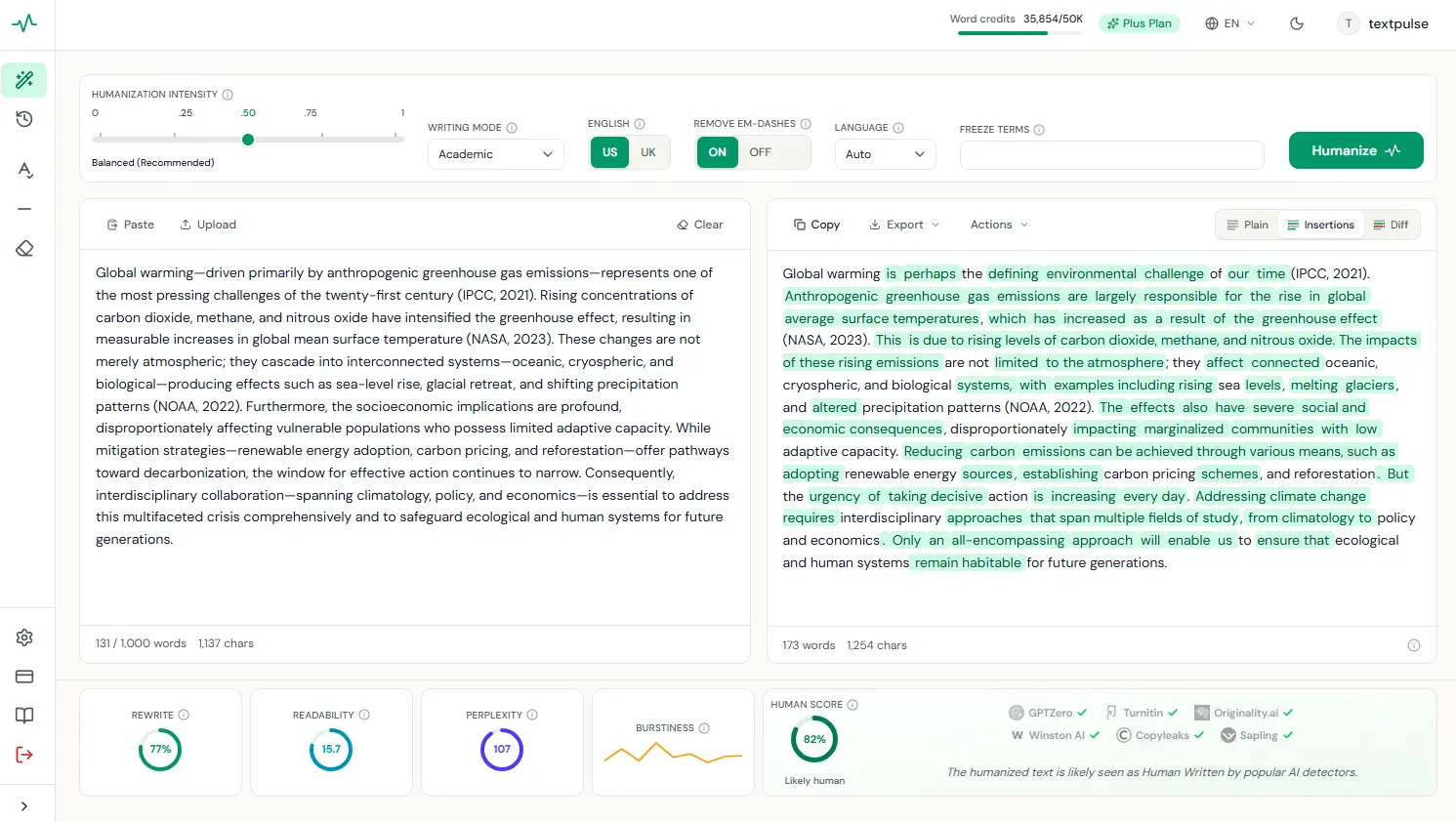
A dedicated AI humanizer tool (sometimes sold as a ChatGPT humanizer, as this is where most drafts start) will apply these edits together, rhythm and vocabulary, in their entirety on a whole document in the time it takes to make coffee, not one paragraph in fifteen minutes. Whatever they're called, AI humanizer tool, AI text humanizer, AI paragraph rewriter or AI to human text converter, the good ones will do the same thing: change the shape and word choice of the sentence while keeping the meaning. How far the wording moves varies from one passage to the next.
TextPulse works this way. It rewrites a full draft and returns an estimated Human Score computed from those same signals, not a promise that any specific detector will pass it. That caution is not unique to us: Grammarly's own AI humanizer page states plainly that its tool is "not intended to bypass AI detectors," a fair description of what any humanizing pass can credibly promise. If you came here looking to make AI text undetectable, the truth is that no edit and no tool can guarantee that, because detectors disagree with each other and change without notice.
A responsible AI humanizer tool can offer a fast first pass and a score to work from. The goal is to reduce an AI score by making the pattern less uniform, not to trick the number directly. An AI rewrite aims for the same thing at the document level that a careful hand edit does at the paragraph level. Add specific, human detail from the section above by hand, because a tool wasn't in the room when the interesting thing happened.
If you're working on a project with a deadline, you can use the AI humanizer for students, which uses the same mechanism but with academic conventions already taken into account. The order matters more than the tool, because a generic sentence in careful prose is still generic. You still need to do the specific-detail pass by hand.
How to humanize AI text in the next ten minutes
Put the edits above in order and they form a short routine, not a checklist to memorize. Applied to one page, roughly 300 to 400 words, here is how the ten minutes splits.
- Read the paragraph aloud once, and mark every sentence that sounds identical in length or shape to its neighbor.
- Break up two or three of the flattest sentences, moving the main claim to the front of each one.
- Search for stock vocabulary such as facilitate, robust, myriad and underscore, and replace each with the plainer word you would actually say.
- Remove or replace repeated dashes and semicolons, reading each fix aloud to check it still sounds natural.
- Add back one specific detail per paragraph, a number, a name, a limitation, that only someone who did the work would know.
- If the draft runs longer than a page or two, run it through an AI humanizer tool for a first pass, then repeat steps one through five on whatever still reads flat.
Several threads here open into pages of their own. Whether these tools work at all and whether they are safe to use on graded work are separate questions with separate answers, and what Turnitin does with humanized text once it is submitted is a third. For narrower problems there are step-by-step pieces on lowering an AI score and on editing ChatGPT output paragraph by paragraph.
None of this produces writing that is undetectable, and no honest guide should promise that it does. It produces writing that sounds like you actually spent the ten minutes, which is the more durable goal: a reader trusts specific, uneven prose whether or not a detector ever sees it.
Related research: the humanizers discussed above are compared head to head in A Controlled Comparison of AI Text Humanizers on Academic Writing, a TextPulse Research working paper with open data and code. Whether prompting alone can make a model write like a person is tested in Do AI Models Speak Human?.
Frequently Asked Questions
Yes, for anything short. Knowing how to humanize AI text by hand comes down to four edits: vary sentence length, cut stock vocabulary, fix repeated punctuation, and add back one specific detail per paragraph. A page takes ten to fifteen minutes. The limit is length: the same care across a long document becomes a multi-hour job, which is where a tool starts to earn its keep.
Content strategist at TextPulse, here since the company started. Mark writes the product and technical coverage: how the humanizer works under the hood, what changes in each release, and what a specification actually means for your writing. His reviews of writing software come from using them on real documents rather than reading a feature list.