How to Lower Your AI Detection Score
A ranked walkthrough of what actually changes an AI detection score, from the edit that barely moves it to the one that moves it most, and why chasing the number itself is the wrong goal.
The student runs a paragraph through a detector, sees a score of 82 percent, swaps a dozen words for synonyms without touching a single sentence's shape, and checks again. The number barely moves. The whole story: some edits change almost nothing, and one changes more than the rest combined, for reasons that have nothing to do with outsmarting software.
This piece works through how to lower AI score in the order that actually matters: which edits barely register, which move the number substantially, and which one moves it the most, and why. It also covers what the number is actually measuring, because a lower score is worth wanting for a real reason, clearer, more specific writing, and a poor goal to chase on its own.
What an AI Score Actually Measures
A language model writes by predicting the next likely word, over and over, which produces a specific statistical fingerprint: sentence lengths that cluster together, transitions drawn from a small set of safe options, word choices that sit near the center of what is expected in that context. An AI detection score is an estimate of how closely a passage matches that fingerprint, produced by a classifier trained to notice it, not a fact about who typed the sentence.
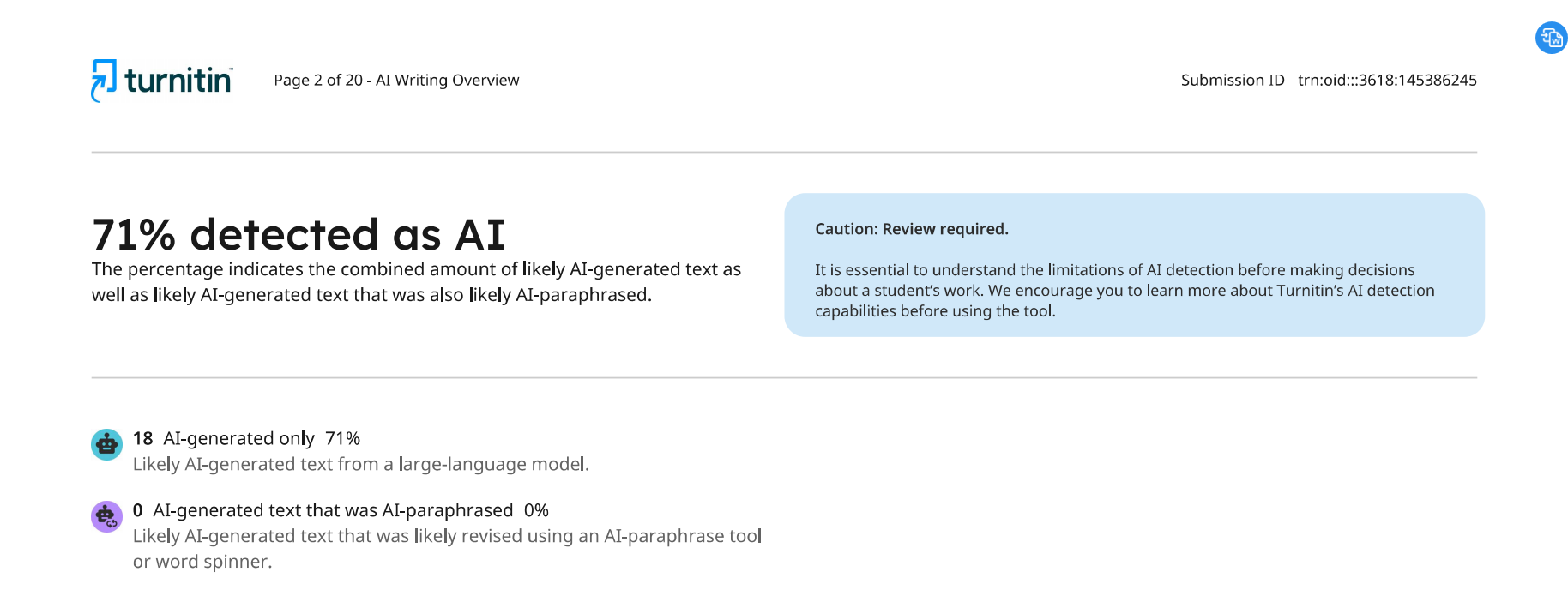
Detectors do not all define the number the same way. Turnitin states plainly that its percentage "indicates the amount of qualifying text within the submission that Turnitin's AI writing detection model determines was likely generated by AI," and is explicit that this is a share of flagged text, not a probability or confidence score. Other detectors output something closer to a confidence value on the sentence itself. Either way, a full explanation of the mechanics behind these numbers is worth reading in how AI detectors work. What matters here is simpler: the number is always a statistical estimate, and every edit below works by changing the statistics it is built to read, not by hiding the fact that a model was involved.
Synonym Swaps Barely Move an AI Score
Swapping a word for a less common synonym changes almost nothing about the pattern a classifier is scoring, because it leaves the sentence's length, clause structure and rhythm untouched. A model trained to notice uniform sentence shape does not care whether a sentence says enables or allows. It cares that three sentences in a row run to almost the same length and open the same way.
A flat sentence reads: "The platform enables users to efficiently accomplish routine tasks without additional training." Swapped word for word, it becomes: "The platform allows users to efficiently complete routine tasks without extra training." Same length, same clause order, same rhythm. A reader might notice a slightly different word. A classifier scoring sentence-level patterns across the paragraph has almost nothing new to work with.
This is not an argument against fixing stock vocabulary. Words like facilitate, robust and myriad are worth cutting because a careful reader notices them, and a free AI word cleaner catches most of them in seconds. It is an argument against expecting that pass to do the heavy lifting. If a score barely moves after a vocabulary pass, that is the expected result, not a sign the pass failed.
Humanize your own paper
Transform your AI-assisted text and make it sound human, without touching important words or citations.
Sentence Variety Moves It Further
A model predicts one token at a time and has no built-in reason to make sentence three shorter than sentence two, so left alone, a paragraph settles into a narrow band of length and shape. That regularity, not any single word, is the stronger signal, because a classifier trained on machine output has seen that pattern thousands of times.
Three flat sentences read: "The results were significant. The findings supported the hypothesis. The data was analyzed using standard methods." Restructured for variety, the same content reads: "The results were significant, and they supported the hypothesis, though the standard analysis needed a second pass once two of the outlying cases were removed." One sentence now carries the claim and its complication together, with real variation in length and clause structure across the paragraph. That is what a burstiness checker is measuring when it scores unevenness, and it is why this edit moves a score more than a vocabulary pass does.
None of this is difficult to do by hand on a page or two. Read the paragraph aloud, mark any run of two or three sentences that sound the same length and shape, and break one of them apart or combine two into one with a comma doing real work. The sentence-level edits behind this section are covered step by step, with more worked examples, in the full walkthrough of how to humanize AI text.
Your Own Evidence Moves an AI Score Most
A language model has no access to what actually happened in your project. Asked to write about a study, it defaults to the safest phrasing that fits almost any study on the same topic, because that is the only material it has. A sentence carrying a specific claim from a specific source is not a sentence a model would have produced from the prompt alone, and that gap is what moves a score the most.
A generic sentence: "The intervention had a positive effect on outcomes for participants." This could describe hundreds of studies. Rewritten using the writer's own material: "Attendance records showed the effect held only for students who came to more than six sessions, a threshold the original design had not anticipated." Longer, more specific, and could only describe this study. A reference model asked to continue the same prompt wouldn't have guessed the six-session detail, because nothing in the prompt suggested it existed.
This is also the edit that most improves the writing regardless of what any detector reports, which is the point worth sitting with. A specific number, a named limitation, a source quoted directly rather than paraphrased into a vague claim: these make a paragraph more convincing to a person reading it, and the fact that they also move a score is closer to a side effect than the goal.
| Edit | Typical effect on the score | Why |
|---|---|---|
| Swap words for synonyms | Small to none | Sentence length, structure and rhythm stay the same |
| Vary sentence length and structure | Moderate to large | Breaks the uniform pattern a classifier is trained to notice |
| Add your own evidence or claims | Largest | Introduces content a model had no way to produce from the prompt alone |
How to Lower AI Score Without Chasing the Wrong Goal
Every number above is an estimate, not a verdict. Turnitin says as much in its own documentation, stating that its AI writing detection "may not always be accurate" and "should not be used as the sole basis for adverse actions against a student." A score can move for reasons that have nothing to do with authorship, and it can stay flat on writing a person wrote from scratch. Treating the number as a fact about who wrote a sentence is where most of the anxiety around this topic comes from, and it is not what the number claims to be.
That's also why lowering the score is a poor goal on its own. Chasing a number can push a writer toward the edits that are easiest to automate, a vocabulary pass, a few reordered clauses, while skipping the one that matters most: adding the specific material only the writer actually has. A lower score earned that way is worth having.
Chasing a lower score can also push a paragraph in the wrong direction stylistically: hedging every claim, stacking qualifiers, adding filler sentences that exist only to break up rhythm rather than to say something. None of that fixes the underlying pattern, and all of it makes the paragraph worse to read. The edits that actually move a score, sentence variety and specific evidence, are also the edits that make writing better on its own terms, which is a useful check when an edit starts to feel like padding rather than improvement.
TextPulse's AI humanizer applies the sentence-level and structural edits above across a full document at once, and reports an estimated Human Score computed from those same signals, not a claim that any named detector will pass it. Used well, it is a fast first pass on a long document. It still cannot add the one thing that moves a score the most, since it was never in the room when the actual work happened. That part stays with the writer.
Two prior questions are worth settling first: whether AI humanizers work at all, and whether they are safe to use on work you intend to submit.
The order above is also a priority list for where to spend limited time before a deadline. Skip the synonym pass if time is short. Do not skip the paragraph where you add back the detail nobody else could have written, because that is the one edit no amount of rewriting software can do in your place.
Related research: the findings above are examined at scale in The Detectability of Partially AI-Rewritten Academic Documents, a TextPulse Research working paper with open data, code and a citable DOI. The humanizers themselves are compared head to head in A Controlled Comparison of AI Text Humanizers on Academic Writing. Whether prompting alone can make a model write like a person is tested in Do AI Models Speak Human?.
Frequently Asked Questions
Adding your own material, a specific number, a named limitation, a claim tied to a source you actually read, moves a score more than any other single edit, because a language model had no way to produce that detail from the prompt alone. Sentence-length variety comes next. Synonym swaps move it least, since they leave sentence structure untouched. That order is the core of how to lower ai score without just gaming the number.
Content strategist at TextPulse, here since the company started. Mark writes the product and technical coverage: how the humanizer works under the hood, what changes in each release, and what a specification actually means for your writing. His reviews of writing software come from using them on real documents rather than reading a feature list.