JustDone AI Humanizer Review
JustDone is a 35-tool writing platform where humanizing is one function, with task-specific modes for emails, blogs and academic content. Pricing runs from a free tier through a $2 seven-day trial that auto-renews into a $19.99 monthly plan, or $9.99 a month charged annually. This review covers what the academic mode does, what a mode cannot enforce, and where TextPulse fits work with a reference list.

JustDone is a writing platform of around 35 tools, and humanizing is one function inside it. The rewriter carries task-specific modes for emails, blogs and academic content, so the setting matches the document instead of treating every text the same way. Pricing covers the whole platform: a free tier, a $2 seven-day trial, $19.99 a month for unlimited use, or $9.99 a month charged annually as $119.88 upfront.
It suits writers who want one subscription covering many jobs rather than a specialist tool for one. This review judges JustDone for academic work: theses, manuscripts and coursework, where the citations get checked as closely as the prose. Of the suite products in this category, it comes closest to taking academic writing seriously, and the sections below cover what its academic mode does and does not protect.
What Universities Actually Allow
Disclosure is the rule at most institutions, and outright prohibition is rare. Oxford's guidance on using AI in study treats these tools as part of the study toolkit and puts the obligation on the student: use them as your course permits, and acknowledge the use. Universities treat unacknowledged use as the breach.
Publisher policy lands in the same place. Nature's editorial policy permits AI assistance in preparing a manuscript and refuses to list a model as an author, because an author has to be answerable for the work. There is a second requirement too: the finished text still has to say what your sources said. A rewrite that shifts a citation or renames an instrument fails that test even when nobody asks which tool produced the sentence. Our AI disclosure statement template covers the wording departments expect.
Why AI Drafts Need Humanizing
Raw model prose is generic in a way readers register before they can name it: sentences of near-identical length, the same few connectives joining them, hedges stacked until no claim commits to anything, paragraphs that close by summarising themselves. Our list of AI words and phrases shows how narrow the vocabulary gets.
The second problem is measurement. Turnitin, GPTZero, Originality.ai and Pangram do not read for meaning. They score how predictable the text is against what a language model would have chosen next, and generated prose scores as highly predictable. Our guide to how AI detectors work sets out the measurement.
Light paraphrasing moves neither problem far. Turnitin's documentation states that its AI indicator covers text humanized or run through a bypasser, and that it separately flags text likely revised with an AI paraphrase tool or word spinner. No humanizer can promise a detector outcome on a specific document.
How AI Humanizers Work
- Varying sentence structure. Detectors measure sentence-length variance directly, so this shifts a score further than any other change. A run of evenly sized sentences broken into a mix of six words and thirty reads differently and measures differently.
- Replacing model-typical vocabulary. Second in effect. On its own it changes texture and leaves structure where it was, which is why synonym-only rewriting disappoints.
- Adjusting register. Third, and the place most general tools go wrong. A rewrite that lowers your reading level to sound more human moves the text away from the register an examiner expects.
What JustDone Is and How Its Modes Work
JustDone puts the humanizer inside a library of roughly 35 writing tools, so the rewriter is one function on the account. The distinguishing feature is mode selection. Instead of one rewrite button applied to everything, the tool asks what kind of text this is, with modes for emails, blogs and academic content, and adjusts the output accordingly.
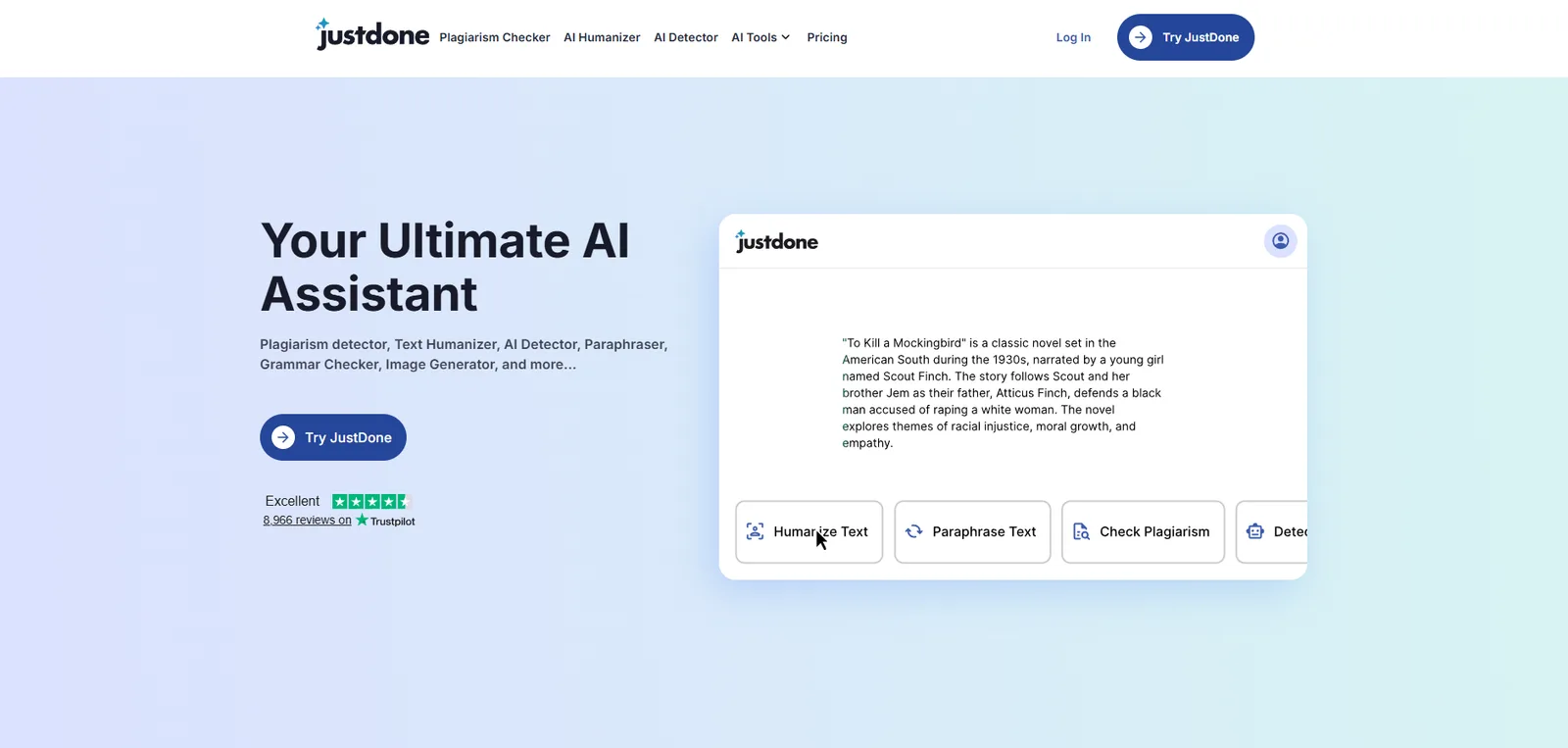
That design matters more than it sounds. Most humanizers serve every user the same rewrite, which is why so much output lands in a chatty register that suits a newsletter and undercuts a literature review. Asking first means a discussion chapter and a product email get different treatment, and the academic mode does real work: register holds, and technical vocabulary survives the pass more often than it does in general tools.
The limit is that a mode is a target rather than a rule. Pointing the engine at academic prose improves the average sentence, but it is not documented protection for citations, defined terms and statistics, where the tool is required to leave a protected string alone. Academic documents are wrecked by the exceptions, and a target only governs the average.
The Feature Set
- Humanizer with task modes. The rewriter, with modes for emails, blogs and academic content, so the register target changes with the document type.
- Built-in AI checking. Basic checks on the free tier alongside a few short scans. Treat any built-in score as a rough signal, because the detector your institution runs is the one that decides.
- A 35-tool platform. The rewriter sits in a wider library of writing tools under one login, which is why most subscribers are there.
- One subscription across tasks. The $19.99 monthly plan covers the platform instead of metering the humanizer, so heavy rewriting carries no separate bill.
The suite argument is the strongest case for JustDone. If you write emails, blog posts, applications and coursework in the same week, paying once beats paying four times, and the workspace is clear enough that finding a function takes no tutorial.
It fits worst for anyone with a reference list. The rewriter is capable, but fifty in-text citations, a construct that has to stay defined and a results section full of numbers need guarantees a mode cannot give.
Humanize your own paper
Transform your AI-assisted text and make it sound human, without touching important words or citations.
Plans, the $2 Trial and What It Renews Into
Pricing is straightforward, with one detail that deserves a plain warning. The free tier gives a few short scans and basic AI checks. Above it sits a seven-day trial at $2, which auto-renews into the monthly plan unless you cancel. The monthly plan is $19.99 for unlimited use, and the annual plan works out at $9.99 a month, charged as $119.88 upfront.
| Plan | Price | What it covers |
|---|---|---|
| Free | No charge | A few short scans and basic AI checks |
| Trial | $2 for seven days | Auto-renews into the monthly plan unless cancelled |
| Monthly | $19.99 a month | Unlimited use of the platform |
| Annual | $9.99 a month, charged $119.88 upfront | Unlimited use of the platform |
Set a calendar reminder the day you start the $2 trial. A trial that rolls into a $19.99 monthly plan unless cancelled is normal practice, and it is also the most common reason people pay for a tool they used once. Spend those seven days on writing that resembles your real work: a passage with citations left in, instrument names intact and a sentence carrying a number, then read the output against the input line by line.
Citations, Terminology, Statistics and Register
The academic mode covers tone. It does not cover the four things a referenced document depends on.
Citations
A rewriter with no citation rule sees (Okonkwo and Reyes, 2021, p. 88) as ordinary text, open to revision like any other string. A surname drifts by a letter. A parenthetical folds into the sentence as narrative attribution. A page number vanishes. Each edit produces competent prose, and each one breaks a reference against your list. JustDone sits in the upper half of the field here, so damage is uncommon, though no rule prevents it. More on what markers catch is in can Turnitin detect paraphrased text.
Terminology and statistics
Key term retention is a strength for JustDone, and it shows: an engine aiming at academic register is less inclined to treat a validated scale name as a synonym opportunity. The remaining risk is the one every general rewriter carries: without a term lock, "randomly assigned" can become "randomly distributed", a different claim about your method. Numbers carry the same problem: effect sizes, intervals and formulas sit inside sentences the rewriter may restructure, and a wrong number reads as fluently as a right one.
Register
Register is JustDone's strongest area. The academic mode aims at a formal target, and output reads like academic prose rather than a blog post wearing a lab coat. The mode does not state a reading band and hold to it, though, and across a 9,000-word chapter that shows up as drift between sections.
How It Scored in Our Testing
JustDone is the strongest suite product we have run on academic documents, and the profile is consistent. Turnitin results sat near the top of the field, close to the best general humanizers, so the engine moves text off the predictable patterns detectors score. Technical vocabulary survived the pass. Academic tone held. The dashboard is clear, and navigating 35 tools takes no learning curve.
Grammar is the main weakness. Output needs a proofreading pass, because a dropped article or a mangled clause costs the time the rewrite saved and gets attributed to you rather than to the tool. Citations landed in the upper half of the field, which means damage is uncommon and unpredictable, since no rule governs it. Language coverage is adequate in English and weaker beyond it.
Taken together, JustDone treats academic writing as a real use case, which most general humanizers do not. But its academic behaviour remains a tendency rather than a guarantee.
JustDone Alternatives
- Undetectable AI. General content at volume, sold as monthly word pools, with a refund if output is flagged. It produced the strongest Turnitin results of any humanizer we ran.
- QuillBot Humanizer. Sits inside the QuillBot paraphrase suite, so it costs nothing extra if you already pay for that.
- Smodin. A student suite with citation generation, essay tools and translation around the rewriter.
- StealthGPT. Built for SEO and copywriting at volume, with a refund promise attached.
Each is a reasonable buy for the work it was built for, and all four are general content designs. For academic documents, where citations, terminology, statistics and register all have to survive the rewrite, use TextPulse. The wider field is compared in our guide to the best AI humanizer.
TextPulse vs JustDone
| Comparison | TextPulse | JustDone |
|---|---|---|
| Built for | Academic documents: theses, manuscripts, coursework | A 35-tool platform covering many writing tasks |
| Published detector evidence | Vendor benchmark on a 2,000 document academic corpus: 92.33% Turnitin AI, 89.12% Originality.ai, 87.91% GPTZero | None stated |
| Citation handling | Citations and reference entries preserved verbatim in APA, MLA, IEEE, Chicago, Harvard and Vancouver | No documented protection rule |
| Terminology control | Freeze Terms locks any construct or instrument name before the rewrite | Academic mode helps, no term lock named |
| Register | Trained on peer-reviewed human writing, held to Flesch-Kincaid grade 13 to 18 | An academic mode aiming at a formal target, no stated band |
| Statistics | Preserved automatically | Not named as protected |
| Price | Pro $19 a month for 25,000 words, Plus $29 for 50,000, or $169 and $259 billed annually | Free tier, $2 seven-day trial that auto-renews, $19.99 monthly, or $9.99 a month charged $119.88 annually |
The Verdict on JustDone
JustDone earns its place on a shortlist. The academic mode is a real advantage, and it puts JustDone ahead of general humanizers that treat every document as a blog post. Register holds, technical vocabulary survives, Turnitin results sit near the top of the field, and the workspace stays clear across 35 tools. If you write across many formats and want one subscription for all of them, $19.99 a month or $9.99 a month billed annually is a sensible purchase, provided you set a reminder to cancel the $2 trial.
For a document with a reference list, the requirements change. Citation preservation across six referencing styles, Freeze Terms, protected statistics and a register held to the Flesch-Kincaid grade 13 to 18 band are named behaviours in TextPulse, and the figures behind them are vendor benchmark measurements on a 2,000 document academic corpus: 92.33% on Turnitin AI, 89.12% on Originality.ai, 87.91% on GPTZero. TextPulse reports an estimated Human Score on each pass and makes no promise about a detector's verdict on your chapter.
The difference shows up in the exceptions. A mode makes the average sentence more academic, and a rule keeps the one citation in fifty that would otherwise have drifted. Pro costs $19 a month for 25,000 words and Plus costs $29 for 50,000, or $169 and $259 billed annually. For a thesis chapter or a manuscript heading to a journal, that is the work the TextPulse academic humanizer was built to do.
Frequently Asked Questions
It handles academic register better than most general humanizers and still falls short of a specialist. The named academic mode does real work on tone and on technical vocabulary, which is more than a single generic setting delivers. JustDone has no documented protection for citations, defined terms and statistics, and those three are what a thesis or a journal manuscript actually depends on.
Content strategist at TextPulse, here since the company started. Mark writes the product and technical coverage: how the humanizer works under the hood, what changes in each release, and what a specification actually means for your writing. His reviews of writing software come from using them on real documents rather than reading a feature list.