Rephrasy AI Humanizer Review
Rephrasy is a student-focused AI humanizer with the most unusual pricing in the category: a $12.99 Quick Pass good for 24 hours, three annual subscriptions from $99 a year, and a $199 lifetime licence with a detector bundled in. This review judges it for academic work, where citations, locked terminology and register all have to survive the rewrite.
Rephrasy is an AI humanizer aimed at students, and its pricing is the most unusual in the category. A Quick Pass costs $12.99 and opens the tool for 24 hours. Three subscriptions sit above it, all billed annually: Growth at $8.25 a month, which comes to $99 a year, Business at $10 a month or $120 a year, and Professional at $18.33 a month or $220 a year. A lifetime licence is $199 paid once, with a built-in detector included.
The product around the rewriter is modest by comparison: student tools and basic modes at entry, three custom styles and API access on Business, higher processing volumes on Professional. This review judges Rephrasy for academic work: theses, manuscripts and coursework, where the reference list gets checked as closely as the prose. Rephrasy offers no citation handling and no terminology lock, and for academic use those two gaps matter more than anything else about it.
What Universities Actually Allow
Disclosure is the rule at most institutions, and outright prohibition is rare. Oxford's guidance for students treats generative AI as a study aid whose acceptability depends on the specific assessment. Each department sets its own terms, and students are expected to know and follow them.
Publishers take the same position. COPE's guidance on authorship holds that a tool cannot take responsibility for a piece of work, so a human author must, and must state what the tool did. Universities apply the same logic to coursework: the breach is undeclared use. A reference that no longer matches the source you read is a separate problem, and no disclosure statement covers it. Our AI disclosure statement template covers the wording most departments expect.
Why AI Drafts Need Humanizing
Raw model prose is generic in a way readers notice before they can name it: sentences of uniform length, connectives collapsed into the same few joins, hedges stacked until a claim commits to nothing. Our list of AI words and phrases shows how small the working vocabulary is.
The second problem is measurement. Turnitin, GPTZero, Originality.ai and Pangram do not read for meaning. They score how predictable each token is against what a language model would have chosen next, and generated prose scores as highly predictable. Our guide to how AI detectors work sets out the measurement.
Detector scores are estimates. Weber-Wulff and colleagues tested fourteen detection tools in the International Journal for Educational Integrity and concluded they are "neither accurate nor reliable", with a bias toward classifying text as human-written. A humanizer can move a score without improving the writing, and no tool can promise a detector outcome on a specific document.
How AI Humanizers Work
- Varying sentence structure. This is the change that moves a detector score furthest, because variance in sentence length is measured directly. A paragraph of similarly sized sentences rewritten into a mix of short and long reads less mechanically and scores differently.
- Substituting model-typical vocabulary. Second in effect. On its own it changes texture and leaves structure where it was, which is why synonym-only rewriting disappoints.
- Adjusting register. Third, and the place general tools go wrong for academic users. Most aim at conversational output because most of their customers write marketing copy, and conversational is the wrong target for a methods chapter.
What Rephrasy Is and How Its Rewriter Works
The core product is a paste-in rewriter with mode selection. The entry plan carries basic modes and student tools. The tiers above add custom styles, three of them on Business, including the ability to clone a writing style so output resembles a sample you supply instead of a generic preset.
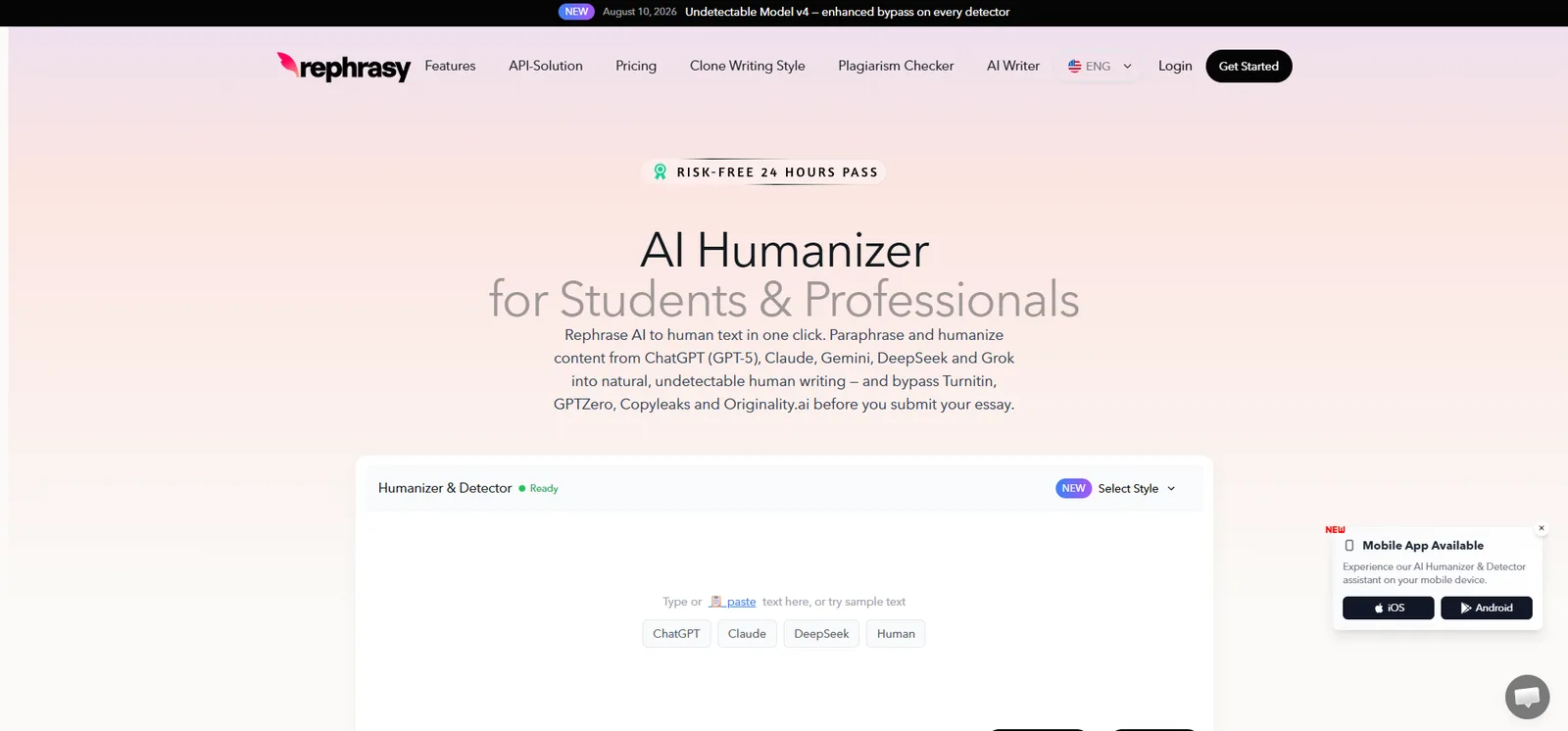
Style cloning suits the audience. It answers a worry generic humanizers ignore: a marker who has read your earlier work notices when the seventh essay sounds like a different person wrote it.
A style is still only a tone control. It governs how sentences sound, not which strings are allowed to change. A rewriter told to write like you is still free to alter a surname, a page number, an instrument name or a p-value, because nothing in a style instruction marks those as off limits. Keep that in mind before using it on a referenced document.
The Feature Set
- The humanizer. The core rewriter, with basic modes from the entry plan.
- Custom styles. Three on Business, including cloning a style from a sample you supply.
- Student tools. Bundled with Growth at $99 a year, the plan Rephrasy points students toward.
- API access. Included from the Business plan at $120 a year.
- Built-in detector. Included with the $199 lifetime licence.
- Higher processing volumes. The distinguishing feature of Professional at $220 a year.
Everything on that list is about tone, volume or access. Nothing on it protects citations, terminology or numbers. So the natural audience is students on a fixed budget, writing general essays and coursework without a formal reference list, where fluency is the whole requirement. The fit weakens the moment a marker cross-checks parentheticals against a bibliography.
Humanize your own paper
Transform your AI-assisted text and make it sound human, without touching important words or citations.
Plans, the Quick Pass and the Lifetime Licence
Most humanizers sell one thing: a monthly subscription that renews until you cancel. Rephrasy sells access over four different time spans, from 24 hours to lifetime, which no other tool in this category does.
| Plan | Price | What it includes |
|---|---|---|
| Quick Pass | $12.99 one time | 24 hours of access |
| Growth | $8.25 a month, billed annually at $99 a year | Student tools and basic modes |
| Business | $10 a month, billed annually at $120 a year | Three custom styles and API access |
| Professional | $18.33 a month, billed annually at $220 a year | Higher processing volumes |
| Lifetime licence | $199 one time | Includes a built-in detector |
The Quick Pass fits how students actually work. Deadlines cluster, so 24 hours of access covers the crunch, and $12.99 paid once avoids the most common complaint in this category: a subscription that keeps renewing long after the deadline has passed.
The lifetime licence is a gamble on the vendor. At $199 once against $99 a year it pays for itself in the third year, and the bundled detector saves a second subscription for checking output. The risk is that detectors retrain constantly, and an engine that clears them today may not clear them in eighteen months. Buy it only if you expect Rephrasy to keep developing the engine for years. Whichever plan you choose, spend the first session on a passage that resembles your real work, citations left in and technical vocabulary intact.
Citations, Terminology, Statistics and Register
A referenced document has four weak points in any rewrite: the citations, the technical vocabulary, the numbers and the register.
Citations
To a rewriter with no citation rule, a parenthetical like (Novak and Bergstrom, 2021, p. 87) is ordinary prose, as open to improvement as any other string. The surname shifts by a letter. The parenthetical folds into the sentence as narrative attribution. The page number vanishes because it did nothing for the rhythm. Each edit produces plausible text, and each one breaks a link a marker checks in seconds against your reference list. Our piece on whether Turnitin can detect paraphrased text covers what happens downstream.
Terminology and statistics
With no term lock available, a rewriter hunting for variation treats a validated instrument name as a synonym opportunity, and "randomly assigned" becomes "randomly distributed", a different claim about your method. Numbers have the same problem: effect sizes, intervals and formulas sit inside sentences the rewriter may restructure, and a wrong figure reads as fluently as a right one.
Register
Cloning your own voice is a better default than generic conversational output. An undergraduate essay voice and the register of a submitted manuscript are still different targets. Tone matching addresses how you sound, and it says nothing about the grade band an examiner reads at, which for academic prose is Flesch-Kincaid grade 13 to 18.
How It Scored in Our Testing
Turnitin results were Rephrasy's strongest showing, consistent with third-party roundups that rate its output well against detectors. The rewriter moves text meaningfully. Grammar was serviceable but not clean, so plan on proofreading the output before it reaches a supervisor.
Citations were the weakest area, and they decide the recommendation. Parentheticals and reference entries are rewritable text to this engine. Key terms fail from the same cause: with no way to freeze a construct or instrument name, controlled vocabulary drifts toward its nearest synonym, and in a thesis that is a substantive error rather than a stylistic one.
Custom styles lift academic tone above the generic conversational default, and the output still lands short of a consistently held academic register. The dashboard is straightforward and quick to learn: paste, choose a mode, run. Language coverage is adequate rather than a strength, so test your own language on the Quick Pass before committing to a year.
Rephrasy Alternatives
- Undetectable AI. General content at volume, sold as monthly word pools, with a refund if output is flagged. It produced the strongest Turnitin results of any humanizer we ran.
- QuillBot Humanizer. Sits inside the QuillBot paraphrase suite, so it costs nothing extra if you already pay for that.
- StealthGPT. Built for SEO and copywriting at scale.
- Smodin. Aimed at students already using its essay tools.
All four are built for general content, so none of them fixes the academic weaknesses described above. For theses and manuscripts, where citations, locked terminology and register all have to survive the rewrite, use TextPulse. The wider field is compared in our guide to the best AI humanizer.
TextPulse vs Rephrasy
| Comparison | TextPulse | Rephrasy |
|---|---|---|
| Built for | Academic documents: theses, manuscripts, coursework | Students on general work, to a fixed budget |
| Citation handling | Citations and reference entries preserved verbatim in APA, MLA, IEEE, Chicago, Harvard and Vancouver | None named |
| Terminology control | Freeze Terms locks any construct or instrument name before the rewrite | None named |
| Register | Peer-reviewed training data, held at Flesch-Kincaid grade 13 to 18 | Custom styles, a tone control with no stated band |
| Published detector evidence | Vendor benchmark on a 2,000 document academic corpus: 92.33% Turnitin AI, 89.12% Originality.ai, 87.91% GPTZero | None stated |
| Long documents | Processed whole, so terminology does not drift between sections | Higher processing volumes on Professional, with no consistency rule stated |
| How you pay | Pro $19 a month for 25,000 words, Plus $29 for 50,000, or $169 and $259 billed annually | $12.99 Quick Pass, annual plans from $99, $199 lifetime licence |
The Verdict on Rephrasy
Rephrasy deserves credit for its pricing. The $12.99 Quick Pass suits deadline work far better than a subscription that renews for eleven months after the essay is in, and the $199 lifetime licence with a bundled detector is rare in a market built on recurring billing. Style cloning is also a more credible pitch than the one-click bypass claims most rivals lead with.
For documents with a reference list, the answer changes. Custom styles control how output sounds. They do nothing to stop a surname drifting, a page number disappearing, an instrument name being swapped for a synonym or an effect size ending up as a different number. Those are the failures that cost marks, and Rephrasy has no feature that addresses any of them.
For theses, manuscripts and coursework with sources, use TextPulse. Citations and reference entries survive verbatim across six referencing styles. Freeze Terms locks any construct or instrument name before the rewrite runs. Statistics and chemical formulas are preserved automatically, and documents are processed whole so terminology does not drift between sections. Register is held in the Flesch-Kincaid grade 13 to 18 band because the training data is peer-reviewed human writing. Pro costs $19 a month for 25,000 words and Plus costs $29 for 50,000, or $169 and $259 billed annually. The vendor benchmark on a 2,000 document academic corpus reports 92.33% on Turnitin AI, 89.12% on Originality.ai and 87.91% on GPTZero, and each pass returns an estimated Human Score rather than a promise about a detector's verdict.
Frequently Asked Questions
It is built for students on general coursework rather than for referenced documents. Rephrasy offers modes and custom styles but no citation handling and no terminology lock. That is workable for a reflective essay with no bibliography. For a thesis or a manuscript it is a real risk: the engine treats parentheticals, instrument names and statistics as ordinary rewritable text, and a broken reference reads just as fluently as a working one.
Content strategist at TextPulse, here since the company started. Mark writes the product and technical coverage: how the humanizer works under the hood, what changes in each release, and what a specification actually means for your writing. His reviews of writing software come from using them on real documents rather than reading a feature list.