HIX Bypass AI Humanizer Review
HIX Bypass is the bypass module of the HIX.AI family, sold on a low entry price, three rewrite modes and a bundled multi detector checker. Standard costs $14.99 a month, or $9.99 billed yearly, and caps every submission at 3,000 words. This review covers the pricing, the input cap, the detector by detector marketing, and what happens to citations and terminology in a referenced document.
HIX Bypass costs $14.99 a month, or $9.99 a month billed yearly, and that plan carries 5,000 humanizer words and 5,000 detector words with a 3,000 word limit on every submission. It is the bypass module of the wider HIX.AI family. You paste text a language model wrote, choose how hard the rewrite should push, and a bundled checker runs the result past several detectors in one place.
Short marketing copy and general web content are what the product is built around, and at that price it serves them well. This review judges it on academic documents: a thesis chapter, a journal manuscript, assessed coursework. That is a stricter test, because an academic rewrite has to leave citations, instrument names and reported statistics exactly as they were, and hold a formal register across forty pages.
What Universities Actually Allow
Most institutions permit AI assistance with your own draft, and the published rules govern disclosure. Elsevier's policy allows generative AI to improve the readability and language of a manuscript, provided the use is declared in the paper. Nature permits the same assistance and adds one limit: a model cannot be listed as an author, because authorship carries accountability that software cannot hold.
COPE reaches the same place from the ethics side. A tool cannot take responsibility for the work, so a human author must, and has to say what the tool did. Universities apply that principle to student writing, and unacknowledged use is the breach.
Why AI Drafts Need Humanizing
Raw model prose is generic. It settles into a narrow band of sentence lengths, leans on flat connectives, and stacks hedges until a finding only might possibly suggest something. A supervisor reads that as thin writing before any software is involved. Our list of AI words and phrases covers what gives it away fastest.
The second problem is measurement. Turnitin, GPTZero, Originality.ai and Pangram score how predictable a passage is against what a language model would produce, and generated prose is predictable by construction. Turnitin's documentation states that its AI indicator covers text which has been humanized or run through a bypasser, and it separately flags writing likely revised by an AI paraphrase tool or word spinner. The mechanics are in our guide to how AI detectors work.
How AI Humanizers Work
- Varying sentence structure. Sentence length variance is measured directly, so this moves a detector reading further than anything else does.
- Replacing model typical vocabulary. The recurring lexicon of generated prose is a strong signal on its own, and swapping it changes texture while leaving structure where it was.
- Adjusting register. General tools aim at conversational prose, the wrong destination for a methods section. Loosening an academic paragraph lowers a detector reading and damages the paper at once.
What HIX Bypass Is and How It Rewrites
HIX Bypass sits inside the HIX.AI family as the module dedicated to one job: you paste a passage, choose how hard the rewrite should push, and get the rewritten version back.
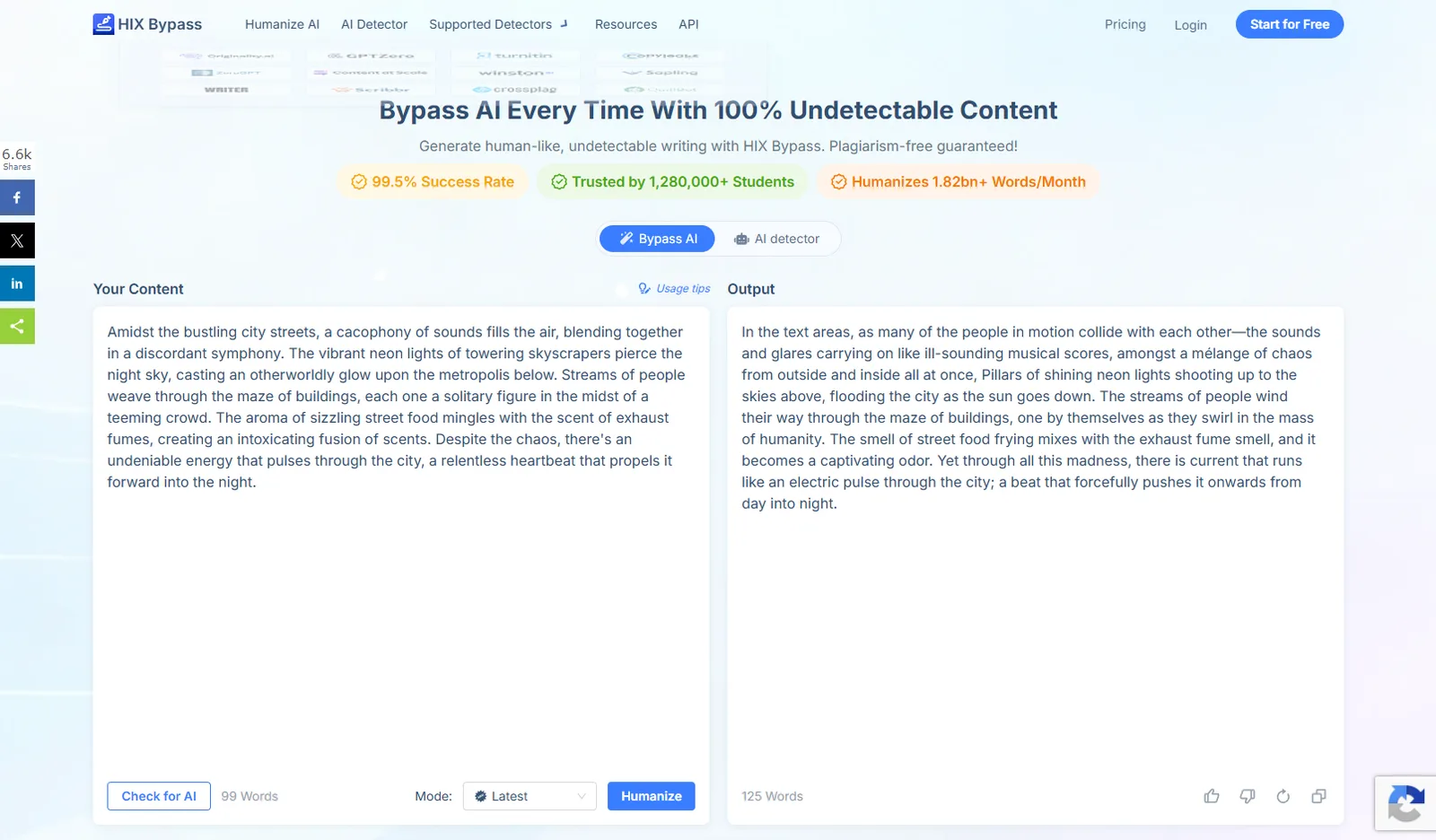
The engine is offered through three modes. Fast Mode is the light pass. Aggressive Mode pushes harder and replaces more of the surface of the text. Latest Mode runs the newest version of the engine. Exposing that choice is genuinely useful, and most competitors hand you one behaviour and no dial.
The Feature Set
On the Standard plan the vendor lists a large language model behind the rewrite, the three modes, plagiarism free content, error free outputs, more than fifty languages supported, privacy safeguards, no distortion humanization, enhanced readability and flow, and tone matching.
Every item on that list is a general content claim. Tone matching is real, but tone is a long way from academic register, and no register target is named anywhere in the list. No distortion humanization is a claim about meaning. An academic document needs a rule that protects specific strings: an author surname, a scale name, an effect size.
Choosing Between the Three Modes
The mode choice is the most useful control the product gives you. The trade is simple: the harder a rewrite pushes, the more of the original text it replaces, and the strings you need left alone, surnames, scale names, reported figures, are part of that text. An aggressive pass moves a detector reading further and touches more author surnames, instrument names and reported figures on the way.
On general content, start light, check, and escalate only the passages still reading as generated. On referenced work, add a step: after each escalation, reread the citations and defined terms in the passage you pushed harder, because that is where the extra change landed.
Who Uses It
The natural customer produces short form general content with one detector in mind: content writers, marketers, students working on short pieces. Support for more than fifty languages widens that audience, and $9.99 a month billed yearly puts the entry price near the bottom of the category.
A Name Collision Worth Knowing About
HIX Bypass and BypassGPT are separate products, on separate root domains, from different outfits. Listicles conflate them constantly, so a price or word allowance attributed to one is frequently the other's. Confirm which product a page describes before you rely on its figures.
HIX Bypass Pricing
| Plan | Price | Humanizer words | Detector words | Input limit |
|---|---|---|---|---|
| Standard | $14.99 a month, or $9.99 billed yearly | 5,000 a month | 5,000 a month | 3,000 words per submission |
| Unlimited | $59.99 a month | No cap | No cap | No cap |
Five thousand words a month is thin for a thesis writer, and the deciding number sits beside it: the 3,000 word input limit determines whether your chapter goes through at all.
Why the Input Cap Decides Whether a Chapter Works
A typical thesis chapter runs well past 3,000 words, so it goes through in pieces that are rewritten independently, and the seams are the expensive part. Terminology drifts between segments, so a construct named one way in the first half acquires a near synonym in the second. Tense shifts at a boundary. A citation straddling a split can break. The Unlimited plan at $59.99 a month removes the cap and costs six times as much.
Humanize your own paper
Transform your AI-assisted text and make it sound human, without touching important words or citations.
Citations, Terminology, Statistics and Register
HIX Bypass describes no citation handling, no terminology locking and no academic register target. On a blog post none of those matter, so their absence costs nothing. On a manuscript each one is a place the document can break silently.
Citations break first. Without a citation rule, a rewriter treats a parenthetical such as (Nguyen et al., 2024, p. 213) as ordinary prose it may improve. Author surnames become vocabulary, narrative citations get restructured with the sentence around them, and a page number disappears with nothing on screen to flag it.
Terminology breaks next. A validated instrument name or defined construct can come back as a plausible synonym, which changes what your methods section claims, and varying vocabulary is exactly what lowers a detector reading. Statistics carry the same exposure: effect sizes, confidence intervals and p values sit inside sentences being rewritten around them, and an edit that touches a number changes the claim.
Register drifts third, toward the engine's default reading level, which for a general tool is conversational. The checking work moves to you: reread every citation, instrument name and reported figure against the original. What a synonym level rewrite does to a plagiarism check is covered in can Turnitin detect paraphrased text.
What Detector by Detector Marketing Optimises For
The marketing is organised detector by detector, with dedicated pages naming Sapling, Content at Scale, GPTZero, ZeroGPT, Copyleaks, Winston AI and Turnitin. That structure tells you what the product is tuned to do.
A product sold on beating GPTZero is optimised to move a GPTZero reading, and that reading is a moving target. Every detector vendor retrains and ships new classifier versions in response to tools like this one, so a rewrite tuned to last quarter's classifier carries no guarantee about next quarter.
Detectors Also Disagree With Each Other
A study in the International Journal for Educational Integrity put 160 academic papers of over 4,000 words through Pangram, GPTZero, Copyleaks and Turnitin. Pangram flagged 97.5% of the fully AI generated papers and 92.5% of the humanized ones. Turnitin flagged none of the fully AI generated set and half of the humanized set. All four cleared 100% of the human written papers.
A rewrite tuned to one classifier says little about the others, and your institution picks which one it runs. A document centred humanizer aims at something steadier: prose that reads like academic writing, because its rhythm, vocabulary and register match how researchers write. That property degrades slowly, since no single classifier defines it, and it also survives the marker who knows what work in the field sounds like.
How It Scored in Our Testing
Language coverage was the strongest part of the result: the non English output held together better than much of the field manages. Detection movement was the other strength, which follows from what the product is optimised to do.
Defined constructs and instrument names were held unreliably, and in a methods section that changes meaning rather than wording. The register that came back was general prose in place of scholarly writing. Citations survived some passes and were edited in others, because nothing in the product commits the engine to leaving one alone. Grammar was readable, with occasional strained joins where a sentence had been restructured hard. The dashboard is built for a paste and rewrite loop, and it is thin for a single long document you return to over several weeks.
The two things HIX Bypass is built to do, shift a detector reading and work in many languages, are the two it handles best. The academic measures sit at the bottom because they were never the target.
HIX Bypass Alternatives
- Undetectable AI. General content at volume, sold as monthly word pools, with a refund if output is flagged.
- StealthGPT. SEO and copywriting at volume, with a refund promise of its own.
- Phrasly. General student and marketing drafts, with a document editor attached to the rewriter.
- WriteHuman. Short form general writing, returning several variations of a passage.
All four are general content designs, so none of them changes the academic answer. For a referenced thesis chapter or a journal manuscript, use TextPulse. The wider field sits in our best AI humanizer guide.
TextPulse vs HIX Bypass
| What you are comparing | TextPulse | HIX Bypass |
|---|---|---|
| Built for | Academic documents, processed whole | Short form general content aimed at named detectors |
| Published detector evidence | Vendor benchmark on a 2,000 document academic corpus: 92.33% Turnitin AI, 89.12% Originality.ai, 87.91% GPTZero | Detectors named page by page, with no measured pass rate attached |
| Citation handling | Citations and reference entries preserved verbatim in APA, MLA, IEEE, Chicago, Harvard and Vancouver | Not described |
| Terminology control | Freeze terms lock any construct, instrument name or technical phrase before the pass | Not described |
| Register | Trained on peer reviewed writing, held to Flesch-Kincaid grade 13 to 18 | Tone matching, with no register target set |
| Capacity per pass | Whole documents, with no seams between fragments | 3,000 words per submission on Standard, uncapped on Unlimited |
| Price | Pro $19 a month for 25,000 words, Plus $29 for 50,000, or $169 and $259 billed annually | $14.99 a month, or $9.99 billed yearly; Unlimited $59.99 |
The Verdict on HIX Bypass
HIX Bypass earns credit on three counts. The three modes give you real control over how hard the engine pushes, which most tools in this band withhold. A multi detector checker sitting next to the rewrite box saves a second subscription. Language coverage held up better than the category average. For short form general content aimed at a particular detector, at $9.99 a month billed yearly, it is a sensible buy.
For academic documents, use TextPulse. Citations and reference entries are preserved verbatim across APA, MLA, IEEE, Chicago, Harvard and Vancouver, so a rewrite cannot quietly edit an author surname or a year. Freeze terms lock a construct or an instrument name before the pass runs. Statistics, effect sizes and formulas are preserved automatically. Register is held at Flesch-Kincaid grade 13 to 18. Documents process whole, whether run one at a time or in a batch through the TextPulse humanizer API, so there are no seams where terminology drifts. Pro costs $19 a month for 25,000 words and Plus costs $29 for 50,000, or $169 and $259 billed annually.
The vendor benchmark across a 2,000 document academic corpus reports 92.33% on Turnitin AI, 89.12% on Originality.ai and 87.91% on GPTZero. TextPulse reports an estimated Human Score on each pass and makes no promise about a detector's verdict on your chapter. On a submission that carries a reference list, start at the academic AI humanizer.
Related research: the humanizers discussed above are compared head to head in A Controlled Comparison of AI Text Humanizers on Academic Writing, a TextPulse Research working paper with open data and code.
Frequently Asked Questions
The Standard plan is $14.99 a month, or $9.99 a month billed yearly, and it covers 5,000 humanizer words and 5,000 detector words a month with a 3,000 word limit on every submission. The Unlimited plan at $59.99 a month removes the allowance and the input cap. Check the input limit against your chapter length before you subscribe, because that number decides whether a chapter goes through whole.
Content strategist at TextPulse, here since the company started. Mark writes the product and technical coverage: how the humanizer works under the hood, what changes in each release, and what a specification actually means for your writing. His reviews of writing software come from using them on real documents rather than reading a feature list.