Phrasly AI Humanizer Review
Phrasly is an AI humanizer and stealth writer with a document editor, a paraphraser and an API behind one login, starting at 550 free words without a card. This review judges it for academic work, where citations, instrument names and reported statistics have to survive the pass intact. It also examines its claim to bypass Anthropic's watermark, a much harder thing to promise than the marketing suggests.
Phrasly gives you 550 words free without a card, and around the humanizer sit Phrasly Pages, a document editor that develops full drafts from an outline or a topic, an AI writer, a paraphraser and an API. The company positions the product as an AI stealth writer and AI detection remover, and claims more than 3,000,000 users. Subscription plans, billed monthly or annually, sit above the free tier.
That package suits general content writers, marketers and students working on drafts with no reference list. This review judges it on academic work: theses, manuscripts and coursework, where the citations get checked as carefully as the prose.
What Universities Actually Allow
Most institutions permit AI assistance and require you to declare it. Nature's editorial policy permits generative AI in the writing process and rules out any model as a listed author, because an author has to be answerable for the work. COPE arrives at the same place from the ethics side: a tool cannot take responsibility for the work, so a human author must, and must state what the tool did.
Universities follow the same logic, and the breach is almost always the failure to declare rather than the assistance itself. What matters after a humanizing pass is whether the text still cites what you read. Our AI disclosure statement template covers the wording departments expect.
Why AI Drafts Need Humanizing
Raw model prose is generic in a way readers notice before they can name it: sentences of uniform length, connectives flattened into the same few joins, hedges stacked until a claim commits to nothing, paragraphs closing on a formulaic summary. Our list of AI words and phrases shows how narrow the vocabulary is.
The second problem is mechanical. Turnitin, GPTZero, Originality.ai and Pangram do not read for meaning. They score how predictable the text is against what a language model would have chosen next, and generated prose scores as highly predictable. How AI detectors work sets out the measurement.
Paraphrasing alone fixes neither problem. Turnitin's documentation states that its AI indicator covers text that has been humanized or passed through a bypasser, and it separately flags text likely revised using an AI paraphrase tool or word spinner.
How AI Humanizers Work
- Varying sentence structure. This moves detector readings most, because sentence length variance is measured. Breaking a run of even twenty word sentences into a mix of short and long changes the statistical shape of a passage.
- Replacing model typical vocabulary. Second in effect, and on its own it changes texture while leaving structure where it was.
- Adjusting register. Third, and the place general tools go wrong for academic users. Most aim at conversational, because most of their customers write marketing copy, and conversational is the wrong target for a methods chapter.
What Phrasly Is and How Its Rewrite Engine Works
The core product rewrites text you paste in, with adjustable rewrite strength controlling how far the output travels from your input. A light setting keeps more of your phrasing. A stronger setting rewrites harder and drifts further from what you wrote.
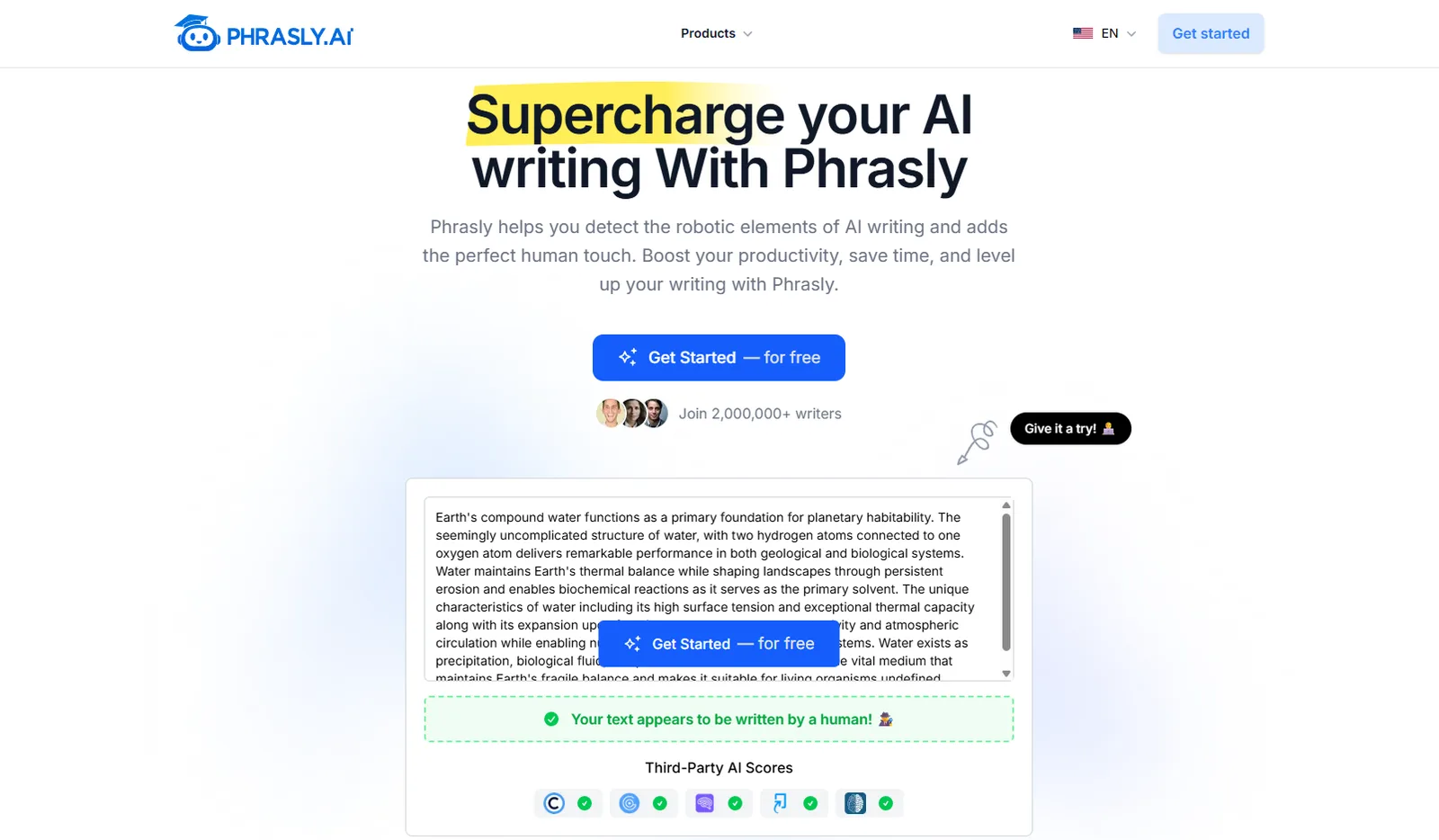
The company says its models are trained on real human data rather than synthetic content, and that its in house models produce results without watermarks or telltale AI patterns. That is a coherent design argument. A model trained on human writing has a different output distribution from one trained on model output, and distribution is what detectors measure. What it lacks is a published test: a run against named detectors on a defined set of documents.
The Feature Set
- AI humanizer and paraphraser. The core rewriter, with adjustable rewrite strength.
- Phrasly Pages. A document editor that develops full drafts from an outline or a topic, so drafting and rewriting happen in one place.
- AI writer. Generation from a prompt, for people who want the draft produced rather than pasted in.
- API. Programmatic access for teams putting the rewriter inside their own pipeline.
Pages sets Phrasly apart from humanizers that offer only a text box and a button. For a writer producing general content, an editor and a rewriter behind one login removes real friction from the day.
Who Phrasly Is For
The user claim points at a broad audience and the feature set matches: content writers producing marketing and SEO copy at volume, students on general essays, teams using the API. The common factor is text with no reference list, no locked terminology and no register requirement beyond fluency.
Humanize your own paper
Transform your AI-assisted text and make it sound human, without touching important words or citations.
Phrasly Pricing and Plans
| Plan | Billing | Word allowance |
|---|---|---|
| Free | No card required | 550 words |
| Subscription, monthly | Billed each month. Price: None stated | Paid capacity above the free tier |
| Subscription, annual | Billed annually. Price: None stated | Paid capacity above the free tier |
Spend the free 550 words on a passage that resembles your actual work, one citation left in and the vocabulary intact. A clean sample only tells you the output is fluent. Then compare the two versions line by line, checking surnames, years, page numbers and instrument names.
The Anthropic Watermark Claim
Phrasly's marketing states that it is "the only humanizer that 100% bypasses Anthropic's AI watermark", published with no dataset, date or method beside it.
Claude's watermark is a statistical bias in which tokens the model selects, embedded in the words themselves. There is no layer of hidden characters to strip and no metadata to clear, which is why retyping the output or replacing odd characters does nothing at all. The visible text carries the signal.
A rewriting tool can therefore remove that signal only to the degree it genuinely changes the text's statistical profile, which is the same job as moving any modern detector. A 100% claim with no published test behind it is a marketing line rather than evidence.
What a watermark claim would need to show
A statistical watermark is read by scoring a passage against the pattern the model was biased toward, so a bypass would be demonstrated like any other detector result: a stated number of documents, a named verifier, a date, and the share that came back clean. The mechanism also makes "only" and "100%" hard to hold together, because any rewriter that changes token choice weakens the signal to some degree, and no rewriter that preserves your meaning changes all of it. Our comparison of humanizers and paraphrasers covers where that trade sits.
Citations, Terminology, Statistics and Register
Phrasly's pages describe rewrite strength and natural sounding output. They name no citation handling, no terminology lock and no academic register target.
Citations
To a rewriter with no citation rule, a parenthetical like (Borg and Steiner, 2022, p. 114) is ordinary text, open to revision like any other string. The surname can drift by a letter, the parenthetical can fold into the sentence as narrative attribution, the page number can disappear. Each edit produces competent prose, and each one breaks a reference a marker will check against your list. More in can Turnitin detect paraphrased text.
Terminology and statistics
Without a term lock, a rewriter hunting for synonyms treats a validated instrument name as a variation opportunity, and "randomly assigned" becoming "randomly distributed" is a different claim about your method. Numbers are the same problem. Effect sizes, intervals and formulas sit inside sentences a rewriter is free to restructure, and a wrong number reads as fluently as a right one.
Register
Natural sounding output suits a blog post but not a literature review. A tool that lowers the reading level to sound more human moves your writing away from the register an examiner expects, and nothing on the Phrasly screen sets an academic target.
How It Scored in Our Testing
Detection movement was its strongest showing, and it supports the company's argument about training on human rather than synthetic text. The rewrite changes the statistical shape of a passage rather than only its wording, which is the mechanism that moves a reading.
Citations and key terms came through better than the feature list predicts, and that is the most interesting part of the result. A lighter rewrite strength setting leaves more of your wording standing, and citations and defined terms survive with it. A setting is doing that work rather than a rule, so raise the strength and the protection goes with it, and nothing on screen reports which parentheticals were kept.
Grammar sat at the weaker end. Harder settings produce more of the usual damage: clauses left hanging after a split, agreement errors where a subject was rephrased. Academic tone drifted below the register a methods chapter needs, with shorter clauses and hedges removed where a researcher keeps them, which follows from aiming at natural sounding prose.
The dashboard is a genuine strength. Pages puts drafting and rewriting behind one login in place of a bare text box, and language coverage is about average for the category.
Phrasly Alternatives
- Undetectable AI. General content at volume, sold as monthly word pools, with a refund if output is flagged.
- QuillBot Humanizer. For existing QuillBot subscribers, inside the paraphrase suite they already pay for.
- StealthGPT. Built for SEO and copywriting at volume, with a refund promise attached.
- Smodin. For students already using its citation and essay tools.
All four are general content designs, so none of them changes the academic answer. For documents where citations, terminology and register have to survive the rewrite, use TextPulse. Our comparison of the humanizer field puts the options side by side.
TextPulse vs Phrasly
| Question | TextPulse | Phrasly |
|---|---|---|
| What it is built for | Academic documents: theses, manuscripts, coursework | General content, stealth writing and drafting |
| Published detector evidence | Vendor benchmark on a 2,000 document academic corpus: 92.33% Turnitin AI, 89.12% Originality.ai, 87.91% GPTZero | None stated |
| Citation handling | Preserved verbatim across APA, MLA, IEEE, Chicago, Harvard and Vancouver | None named |
| Terminology control | Freeze terms lock any construct, instrument name or technical phrase | None named |
| Register | Peer reviewed training data, held at Flesch-Kincaid grade 13 to 18 | Rewrite strength and natural sounding output, with no academic register target |
| Capacity per pass | Whole documents, so no seams where terminology drifts | 550 words on the free tier, more on a subscription |
| Price | Pro $19 a month for 25,000 words, Plus $29 for 50,000, or $169 and $259 billed annually | Free tier of 550 words, with monthly and annual subscriptions above it |
The Verdict on Phrasly
Phrasly deserves credit for something most humanizers skip. A document editor and a rewriter in one place is genuinely convenient, Pages develops a full draft from an outline, the API puts the rewriter inside your own pipeline, and 550 free words let you test the engine before paying anything. If your work is marketing copy, general essays or web content with no reference list, it is a reasonable buy.
For academic documents, use TextPulse. Citations and reference entries are preserved verbatim across APA, MLA, IEEE, Chicago, Harvard and Vancouver. Freeze terms lock a construct or instrument name before the pass runs. Statistics, effect sizes and formulas are preserved automatically. Register is held at Flesch-Kincaid grade 13 to 18, and documents process whole, so terminology does not drift between fragments. Pro costs $19 a month for 25,000 words and Plus costs $29 for 50,000, or $169 and $259 billed annually, all listed on the TextPulse pricing page.
The vendor benchmark across a 2,000 document academic corpus reports 92.33% on Turnitin AI, 89.12% on Originality.ai and 87.91% on GPTZero. Those figures carry the limits of any vendor benchmark, and TextPulse reports an estimated Human Score on each pass rather than a promise about your paragraph. If your document has citations, locked terminology and numbers that have to match a table, start at the TextPulse academic humanizer.
Related research: the humanizers discussed above are compared head to head in A Controlled Comparison of AI Text Humanizers on Academic Writing, a TextPulse Research working paper with open data and code.
Frequently Asked Questions
It is built for general content rather than referenced work. Its pages describe adjustable rewrite strength and natural sounding output, and they name no citation handling, no terminology lock and no academic register target. For a short essay with no reference list that is fine. For a thesis or a manuscript, citations, instrument names and statistics are ordinary rewritable text to it, and every silent change to one is an error a marker will find.
Content strategist at TextPulse, here since the company started. Mark writes the product and technical coverage: how the humanizer works under the hood, what changes in each release, and what a specification actually means for your writing. His reviews of writing software come from using them on real documents rather than reading a feature list.