WriteHybrid AI Humanizer Review
WriteHybrid is a word pool humanizer: 500 words a month free with no card, then $19, $49 and $99 tiers that add priority processing, tone options, team seats and an API. It handled citations more carefully than most general rewriters in our testing, and it describes no citation rule of its own. This review judges it for academic work: theses, manuscripts and coursework.
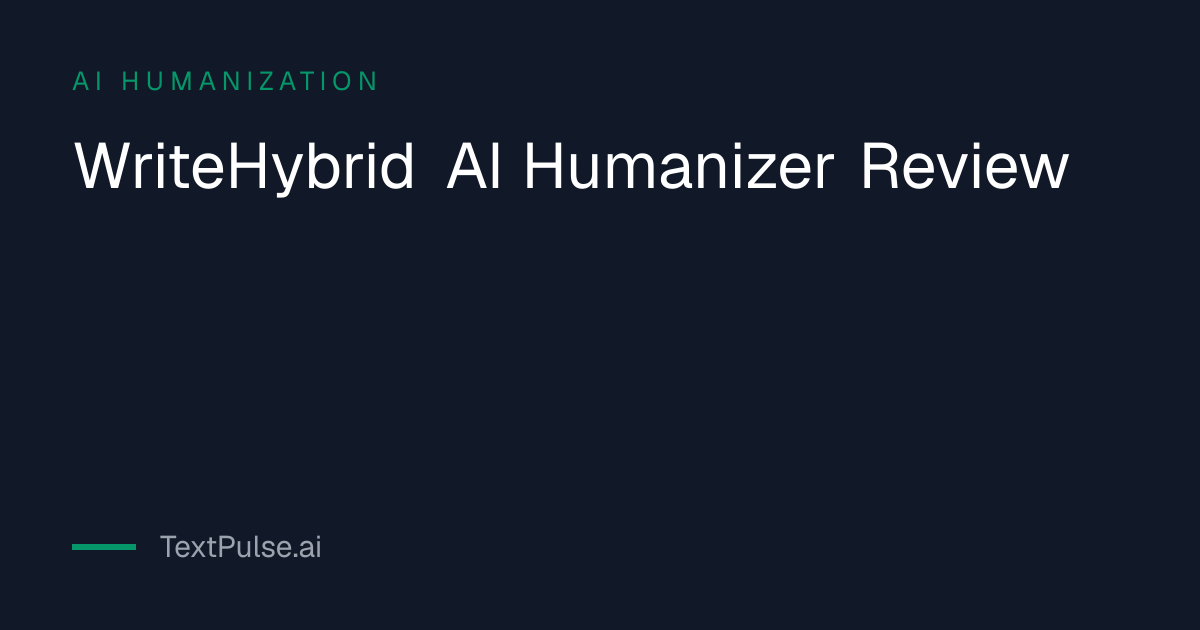
WriteHybrid sells a rewriter against a monthly word pool: 500 words free with no card, $19 for 20,000 words, $49 for 60,000 and $99 for 150,000. You paste a draft into a box and the engine returns a version with different sentence structure and vocabulary. The free tier recurs every month instead of expiring after one use, which is unusual in this category.
The plan ladder is built for content teams, with team seats and an API on the top tier. This review judges the tool for academic work instead: theses, manuscripts and coursework, where the reference list gets checked as closely as the prose. WriteHybrid produced the most careful citation handling of any general rewriter in our testing, and the gap that remains for academic work is specific.
What Universities Actually Allow
Nature's editorial policy allows authors to use these tools for language and readability and refuses to list a model as an author, because an author has to be answerable for the work. Elsevier's policy on generative AI in writing sets the same conditions and asks for a disclosure statement inside the manuscript. University codes follow that shape, and departments treat undeclared use as the breach.
That leaves a second question to put to any humanizer: whether the text that comes back still says what your sources say. A rewrite that moves a page number or renames a construct fails on academic grounds regardless of what you declared. Our AI disclosure statement template covers the wording.
Why AI Drafts Need Humanizing
Two problems push writers toward these tools. The first is stylistic. Raw model prose is generic in a way readers register before they can name it, with sentences of near uniform length, the same few connectives doing all the joining, and hedges stacked until a claim commits to nothing. Our list of AI words and phrases shows how narrow the vocabulary is.
The second problem is mechanical. University grade detectors, Turnitin, GPTZero, Originality.ai and Pangram among them, do not read for meaning. They score how predictable a passage is against what a language model would have chosen next, and generated prose scores as highly predictable. How AI detectors work sets out the measurement.
Light paraphrasing solves neither problem. Turnitin's documentation states that its AI indicator covers text that has been humanized or run through a bypasser, and that it separately flags text likely revised using an AI paraphrase tool or word spinner.
How AI Humanizers Work
- Varying sentence structure. This moves detector scores most, because sentence length variance is measured directly. Breaking a run of even twenty word sentences into a mix of six words and thirty changes the statistical profile of a passage.
- Replacing model typical vocabulary. The recurring lexicon of generated prose is a signal on its own. Swapping it changes the texture of a paragraph and leaves the shape alone.
- Adjusting register. Most general tools aim at conversational prose, because most of their customers write marketing copy. Conversational is the wrong target for a methods chapter.
What WriteHybrid Is and How the Rewrite Engine Works
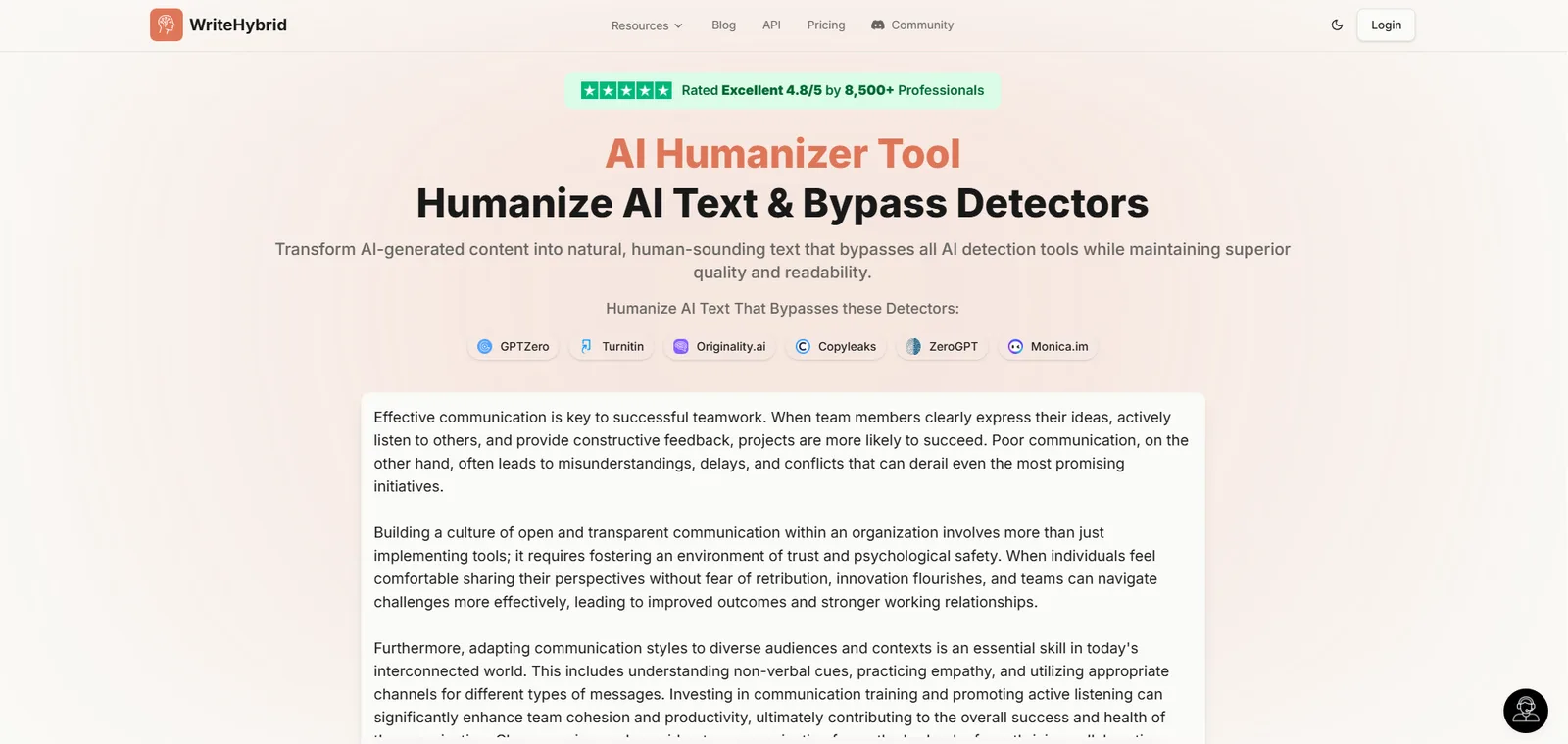
WriteHybrid is a paste in rewriter sold against a monthly word pool rather than a per document charge. You pick a plan, the plan carries an allowance for the month, and each run draws from it. The engine works on structure and vocabulary together, and the output reads as reorganised rather than reworded: the scaffolding of a paragraph usually survives the pass, and so do the parentheticals inside it.
Processing is tiered. Starter runs basic processing and Pro adds priority processing, so queue position is part of what the higher price buys. Tone options appear from Pro upward. Do not mistake them for an academic register target. A tone control selects a style for the output to sound like; a register target holds output inside a specific reading level band, so a literature review comes back at the density an examiner expects. WriteHybrid's tone options are a style control only.
The Feature Set and Who It Is For
- Word pool humanizer. The core rewriter, drawing on a monthly allowance instead of charging per document.
- Recurring free tier. 500 words a month, no card, refreshing every month.
- Priority processing. Queue position on Pro and Agency, above basic processing on Starter.
- Tone options. Style control from the Pro tier upward.
- Team access. Multiple seats on the top tier, working from one allowance.
- API. Programmatic access on the top tier, for calling the rewriter from a publishing pipeline.
The API and the team seats show who this was built for: a content operation with several writers, a queue to manage, and a pipeline that wants the rewriter without anyone opening a browser tab. WriteHybrid serves that buyer well at $99 a month for 150,000 words. An individual researcher needs none of it. A researcher needs a guarantee about what happens to a parenthetical citation and a validated instrument name, and a word pool does not provide that.
Humanize your own paper
Transform your AI-assisted text and make it sound human, without touching important words or citations.
WriteHybrid Pricing and Plans
| Plan | Price | Words per month | What it adds |
|---|---|---|---|
| Free | No card required | 500 | Recurring monthly, not a one time trial |
| Starter | $19 | 20,000 | Basic processing |
| Pro | $49 | 60,000 | Priority processing and tone options |
| Agency | $99 | 150,000 | Team access and an API |
The recurring free tier is genuinely useful. Most humanizers offer one trial that vanishes once spent, which pressures you into testing on whatever text is nearest. A recurring 500 words means you can come back next month with a different passage. Spend it on writing that resembles your real work, citations left in and technical vocabulary intact. A clean sample only shows you that the output is fluent.
Do the arithmetic on the pool before you buy. Humanizing is rarely one pass, and a chapter you run, revise and run again spends its word count twice. An 8,000 word chapter fits twice inside the 20,000 word Starter tier and seven times inside Pro.
Citations, Terminology, Statistics and Register
Citations
Parentheticals mostly came through the rewrite intact: surnames spelled as they went in, years attached to the right names, page numbers still present. That is a real distinction in a field where a rewriter with no citation rule treats a string like (Borg and Steiner, 2022, p. 114) as ordinary revisable text.
The catch is that this is a behaviour the engine tends to produce rather than one the product promises. WriteHybrid documents no citation handling, so a good result is a tendency rather than a guarantee, and tendencies break exactly where a rewriter is under most pressure: dense citation clusters, footnoted legal references, three sources inside one parenthesis. More on that in can Turnitin detect paraphrased text.
Terminology and statistics
Defined terminology mostly held its form instead of being paraphrased into approximations, which is strong for a general tool. The failure mode is a rewriter hunting for variation treating a validated instrument name as a synonym opportunity, so "randomly assigned" becomes "randomly distributed", a different claim about your method. Numbers are the same problem: effect sizes, intervals and formulas sit inside sentences the rewriter is free to restructure, and a wrong number reads as fluently as a right one. WriteHybrid offers no term lock to close that off.
Register and grammar
Academic tone held up well, above most of the general field, and the output does not slide into the chatty register these tools default to. Grammar is the weak point, and it is the first thing a supervisor reads. Across an 80,000 word thesis it becomes a proofreading job you did not plan for, and the errors are the awkward kind: agreement drift after a restructured clause, a tense that shifts mid paragraph.
How It Scored in Our Testing
Citation handling was the standout: the most careful of any general rewriter in our testing, and the measure where most competitors lose their points. Defined terminology and academic tone both held. The dashboard is clear about what you have spent and what remains in the pool, which matters when a long document is going through in sections.
Turnitin results were middling. The rewrite moves the needle without going as far as the tools engineered specifically to push detector scores down. Non English samples came back weaker than the English ones. Grammar was adequate and no better.
Detector results are worth reading against the research. Weber-Wulff and colleagues tested 14 detection tools and concluded they are neither accurate nor reliable, with a bias toward classifying output as human written. No humanizer result, ours included, is a guarantee about a specific paragraph.
WriteHybrid Alternatives
- Undetectable AI. General content at volume, sold as monthly word pools, with a refund if output is flagged.
- QuillBot Humanizer. Sensible for people already paying for the QuillBot paraphrase suite.
- StealthGPT. Built for SEO and copywriting at volume, with a refund promise attached.
- Phrasly. A humanizer with a document editor attached, for writers who want drafting and rewriting behind one login.
All four are general content designs, so none of them changes the academic answer. For documents carrying a reference list, where citations, locked terminology, statistics and register have to survive as stated behaviour, use TextPulse. Our comparison of the humanizer field puts the wider category side by side.
TextPulse vs WriteHybrid
| Question | TextPulse | WriteHybrid |
|---|---|---|
| Built for | Academic documents: theses, manuscripts, coursework | Content teams producing volume |
| Citations | Preserved verbatim across APA, MLA, IEEE, Chicago, Harvard and Vancouver | Usually survive a pass, with no citation handling described by the product |
| Terminology | Freeze Terms locks any construct, instrument name or technical phrase | Mostly holds its form, with no term lock offered |
| Register | Trained on peer reviewed writing, held at Flesch-Kincaid grade 13 to 18 | Tone options on Pro and Agency, a style control |
| Capacity per pass | Whole documents, so no seams where terminology drifts | Monthly word pool, 500 free to 150,000 on Agency |
| Published detector evidence | Vendor benchmark on a 2,000 document academic corpus: 92.33% Turnitin AI, 89.12% Originality.ai, 87.91% GPTZero | None stated |
| Price | Pro $19 a month for 25,000 words, Plus $29 for 50,000, or $169 and $259 billed annually | Free at 500 words a month, then $19, $49 and $99 |
The Verdict on WriteHybrid
WriteHybrid is a well built product at a fair price. Its citation handling is the most careful of any general rewriter in our testing, defined terminology holds its form, the tone stays formal, and a recurring 500 words a month beats the one shot trials most of the category offers. For general content, or for a team running $99 a month against 150,000 words with an API behind it, it does the job it was designed for.
The remaining gap for academic work is narrow and specific. Grammar slips mean a long document comes back needing a proofreading pass. The citation result is a tendency with no guarantee behind it, and that difference shows on the passages where a thesis is densest with sources. Tone options select a style, and they do not hold a reading level band. Team seats and an API describe a content operation, not a researcher with one manuscript and a supervisor who checks the references.
For documents that carry references, use TextPulse. Citations are preserved verbatim across APA, MLA, IEEE, Chicago, Harvard and Vancouver. Freeze Terms hold instrument names and constructs fixed. Statistics and formulas are preserved automatically. Documents process whole, so terminology does not drift between fragments, and register stays inside Flesch-Kincaid grade 13 to 18. Pro costs $19 a month for 25,000 words and Plus costs $29 for 50,000, or $169 and $259 billed annually. The vendor benchmark across a 2,000 document academic corpus reports 92.33% on Turnitin AI, 89.12% on Originality.ai and 87.91% on GPTZero, and each pass returns an estimated Human Score with no promise about a detector's verdict on your chapter.
Frequently Asked Questions
It handles citations more carefully than most general rewriters, and it still stops short of what a referenced document needs. Parentheticals came through a pass with surnames, years and page numbers intact. The product describes no citation rule, so that outcome is a tendency you verify by hand. Grammar is the weaker measure, which across an 80,000 word thesis becomes a proofreading pass you did not plan for.
Content strategist at TextPulse, here since the company started. Mark writes the product and technical coverage: how the humanizer works under the hood, what changes in each release, and what a specification actually means for your writing. His reviews of writing software come from using them on real documents rather than reading a feature list.