Does QuillBot Bypass Turnitin?
Turnitin claims its AI indicator already covers paraphrased and humanized text. QuillBot makes no bypass claim for its own rewriting tools. What sits between those two positions, and what it means for a document you are about to submit.
QuillBot does not claim its Humanizer beats Turnitin. Checked on its own product pages, the Humanizer is described as a rewriting feature and the separate AI Detector as a tool that detects AI-generated content, with no accuracy percentage and no detection-bypass claim attached to either. Turnitin, meanwhile, claims the opposite side of the same ground. The distance between those two positions is where this question actually sits.
So, does Turnitin detect QuillBot? Turnitin has no way of knowing which tool touched a document, and it makes no attempt to find out. Its AI writing indicator scores prose for how closely the writing matches the statistical patterns of machine-generated text. A QuillBot pass gets flagged or not flagged on the strength of how much it changed those patterns, exactly like any other rewrite from any other tool.
Does Turnitin Detect QuillBot? What Each Company Says
The answer from Turnitin is clear and published. Its advice answers the question if they are able to detect content paraphrased with an AI paraphrasing tool. Their response is: "Yes, Turnitin's AI indicator includes detection of AI-generated content that may have been paraphrased using a word spinner/AI paraphrasing tool." They answer the same way for humanizers and bypassers. That's a vendor claim about their own product, published without a figure attached to it.
QuillBot makes no matching claim in the other direction. Read on its own pricing and product pages in August 2026, the Humanizer carries no accuracy percentage and no statement about defeating any detector, and the AI Detector is described only as a tool that detects AI-generated content. Several competitors in this category do advertise detector-bypass guarantees on their own sites. QuillBot is not among them.
The two positions are compatible with each other. Turnitin claims coverage of paraphrased and humanized writing inside its model. QuillBot claims a rewriting tool and stops there. Neither statement tells a student what will happen to one specific document, which is the part anyone asking this question actually wants to know.
QuillBot's Tools Are Not Interchangeable
This question involves three separate QuillBot features. Each one operates differently when viewed by a detector. The Paraphraser changes words and short phrases within a piece of writing into different ways of saying the same thing. The AI Humanizer, which comes as part of QuillBot Premium, is a type of rewrite geared towards specific documents generated by an AI. The AI Detector is a checker that reports on text pasted into it. It has no connection to either rewriting tool.
The difference applies to the two rewriters versus the detector. If you run a paragraph through QuillBot's own AI Detector and see a low result, it tells you nothing about what Turnitin will say when they check that same paragraph. Two detectors are two separately trained models with two different thresholds, and they disagree on the same text often enough that neither result predicts the other.
There is also a size constraint worth knowing about on the free tier. QuillBot's free Humanizer caps a submission at 125 words, with a small number of uses per day. Turnitin needs at least 300 words of qualifying prose before it will generate an AI score at all. A student rewriting a full assignment in 125-word pieces is assembling a document that Turnitin then scores as one continuous submission, in overlapping segments that cut straight across the seams between those pieces.
What a QuillBot Pass Changes Inside a Turnitin Report
Turnitin produces two independent reports, and a rewriting pass lands on them very differently. Turnitin states plainly that the AI percentage "is different from and independent of the similarity score," and that AI writing highlights never appear in the Similarity Report at all. The full comparison is set out in the piece on Turnitin's similarity score versus its AI score.
Against the Similarity Report, a paraphrase pass does real work. Similarity checking compares a submission against a repository of web pages, publications and previously submitted papers, then reports matching text. Replacing words breaks those matches. That is the job QuillBot's Paraphraser was built to do, and the reason the product category exists.
Against the AI writing indicator, the same pass has far less to work with. That model never compared the paragraph to another document in the first place. It scores prose sentence by sentence for how closely each sentence matches the patterns of machine-generated writing, then averages those scores across segments. Word substitution leaves sentence length, clause order and connective choice roughly where they were, and those are the features being scored.
| QuillBot feature | What it does | Effect on a Turnitin report |
|---|---|---|
| Paraphraser | Substitutes words and short phrases | Can reduce a similarity match; little effect on the AI indicator |
| AI Humanizer | Rewrites AI-drafted text, a Premium feature | Depends on how much sentence structure the rewrite actually changed |
| AI Detector | Reports its own estimate on pasted text | None. A separate model with no bearing on Turnitin's number |
| Grammar and fluency checks | Corrects mechanics | None. Turnitin's AI model scores patterns rather than correctness |
Humanize your own paper
Transform your AI-assisted text and make it sound human, without touching important words or citations.
Why the Answer Varies From Paper to Paper
Two students can run comparable drafts through the same QuillBot feature and see very different Turnitin scores, for reasons that sit inside Turnitin's pipeline rather than inside QuillBot. The percentage is an average of segment-level scores across a whole document, so how much of the document was rewritten changes the result as much as how well any single paragraph was rewritten.
The number also depends on conditions unrelated to the rewrite. Turnitin generates no AI percentage below 300 words of qualifying prose. Below 20 percent, it shows an asterisk in place of an exact figure, because false positives are more common in that range. And the institution has to have the AI writing feature switched on at all, since administrators can disable it account-wide from their settings page.
Both are Turnitin's published numbers rather than independent findings, and both describe a model that's openly uncertain about any individual sentence. The accuracy numbers from Turnitin also belong in this picture. Turnitin says it has a document-level false positive rate of less than 1 percent for documents with 20 percent or more AI writing, and a sentence-level false positive rate of around 4 percent.
What to Do With This Before You Submit
Nothing above says a QuillBot pass will clear a Turnitin check, and no accurate description of either product could say it. Turnitin says its model covers humanized and paraphrased writing. QuillBot says its tools rewrite. Neither company is positioned to promise what one specific document scores, and any claim that a tool defeats a detector describes a result nobody can observe in advance.
The more useful question is what the rewrite did to the writing itself. A pass that swapped vocabulary and left every sentence the same length has changed how a paragraph reads without touching what a classifier measures. A free AI word cleaner will show which stock words a draft is still carrying, which is worth fixing for a human reader whatever any score says.
For an assessment of QuillBot's Humanizer as a product, including where a synonym pass damages technical terms and who the tool genuinely suits, the QuillBot humanizer review covers it separately. This piece stays on the Turnitin question and nothing else.
The editing that moves a Turnitin AI score is structural: sentence length that varies, clause order that shifts, hedges cut, and specific material a model had no way to produce. That work is set out step by step in the guide on how to humanize AI text, and it is the same work whichever tool ran the first pass.
TextPulse's AI humanizer applies those structural edits across a full document and reports an estimated Human Score computed from the text itself, never a prediction of what Turnitin will report. No tool can see inside another company's model, and the products that say they can are selling a certainty they do not have.
Grammarly raises the same question with a different answer, and that comparison sits on a separate page. Paraphrasers also create a quieter problem in academic drafts: in-text citations that stop matching the reference list.
Whatever any rewriting tool reports, the question a marker asks is about the work rather than the software. A draft history, a set of notes, sources the writer can talk about without opening them: that evidence is available to anyone who did the work, and it holds up on a day when a percentage does not.
What Our Own Research Found
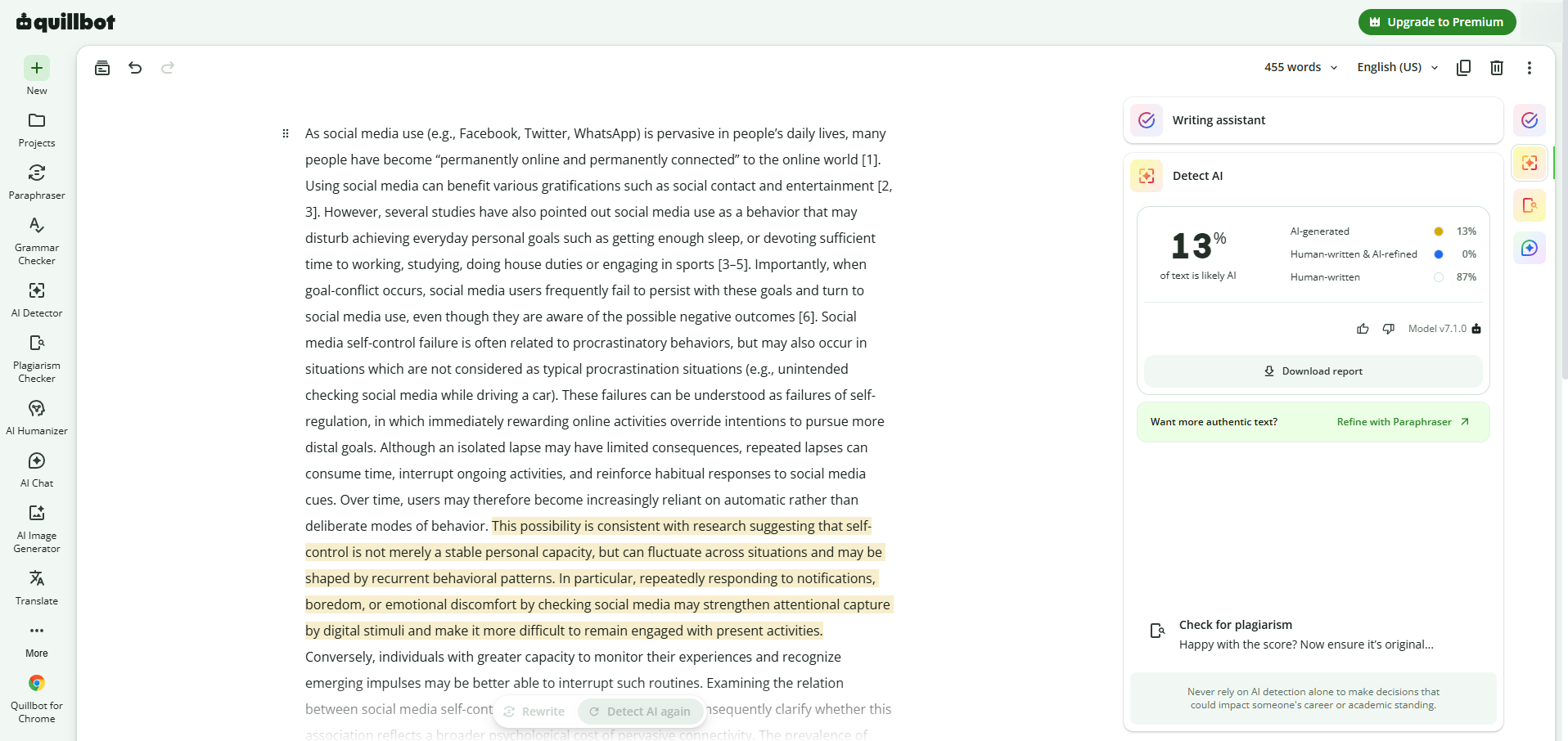
In the TextPulse Research detector agreement study, nine commercial AI detectors rated the same 90 academic texts. One was a 455-word hybrid text: a human-written opening and closing around a 168-word AI-generated middle. QuillBot scored this text 13% AI, while verdicts from the other tools on the same words ranged from 0% to 95.7% AI. The full paper, corpus, and per-tool score matrix are open access at TextPulse Research.
Related research: the humanizers discussed above are compared head to head in A Controlled Comparison of AI Text Humanizers on Academic Writing, a TextPulse Research working paper with open data and code.
Frequently Asked Questions
Turnitin cannot identify which tool edited a document, so the answer to does Turnitin detect QuillBot depends on the writing rather than the tool. Turnitin states its AI indicator covers content paraphrased with a word spinner or AI paraphrasing tool, and content run through a humanizer or bypasser. It reports a percentage of qualifying text, never a tool name.
Content strategist at TextPulse, here since the company started. Mark writes the product and technical coverage: how the humanizer works under the hood, what changes in each release, and what a specification actually means for your writing. His reviews of writing software come from using them on real documents rather than reading a feature list.