What Is a Good Turnitin Score?
Turnitin publishes no acceptable similarity percentage, and institutions set their own guidance instead. This post explains what actually drives a high or low score, why quoted material and reference lists inflate it without anything being wrong, and how to read the match breakdown behind the number rather than the number itself.
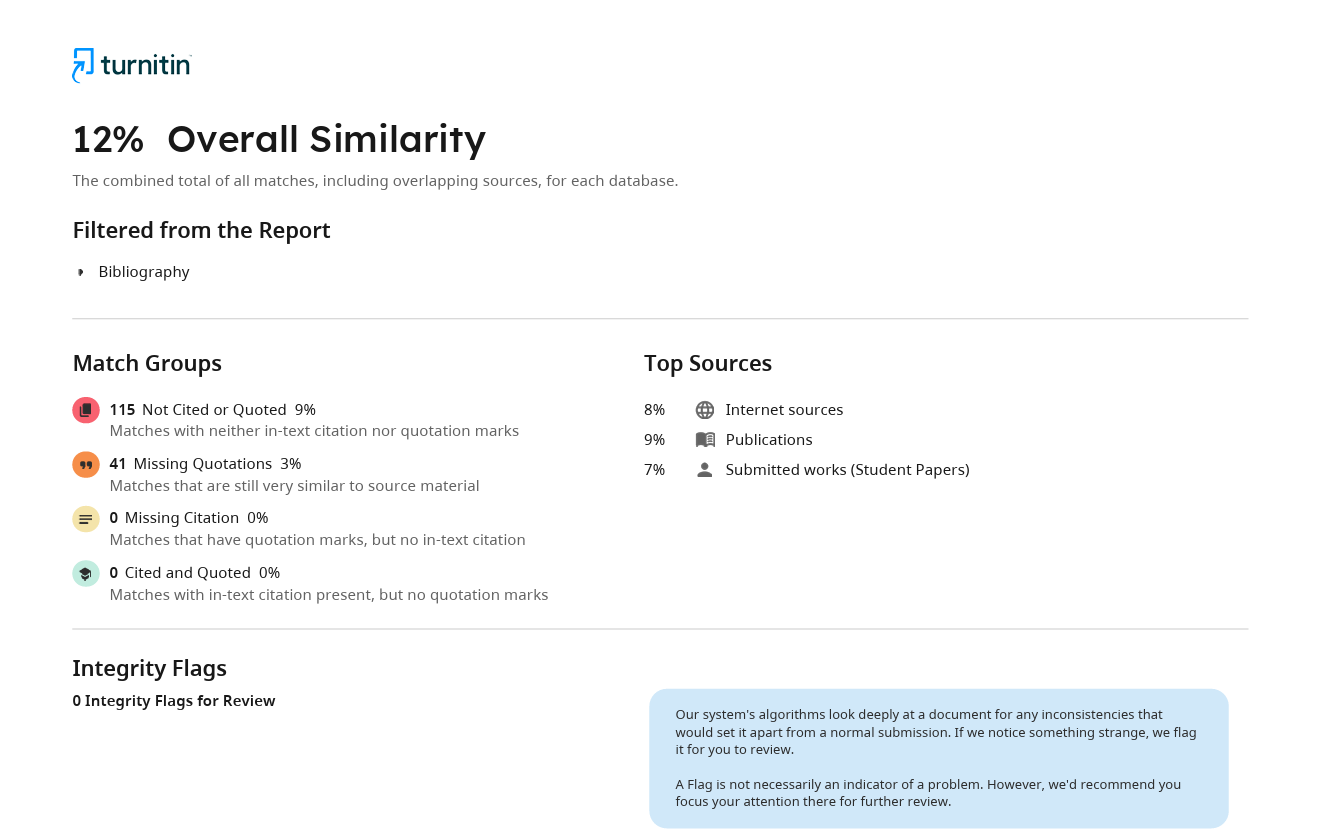
One student is told by a supervisor that anything under fifteen percent is fine. Another student, also in the same department, has his paper flagged down the corridor at twelve percent as three of those points fall within one unbroken paragraph with no quotation marks near it. Both read Turnitin's similarity score correctly. The tool was never built to hand out a single pass or fail number in the first place.
So what is a good Turnitin score? There's no such number. Turnitin doesn't publish an acceptable percentage, does not grade a submission, and says plainly that the figure isn't a measure of plagiarism on its own. Every institution sets its own guidance, and often every supervisor inside it does too, which is why the same report can look unremarkable in one office and worrying in the next. The number worth learning is how to read what sits behind it.
What Is a Good Turnitin Score?
Turnitin has never published a number that counts as good, safe or acceptable, and for a specific reason: the similarity score measures how much text in a submission matches text already inside Turnitin's databases, not whether that overlap was used improperly. A high score can come entirely from material that is quoted and cited correctly. A low score can sit above a paper that paraphrases one source closely enough to trouble an examiner, without tripping the matching engine at all. Reading the number as a grade gets the tool backwards.
A figure like ten to twenty percent circulates widely as an informal rule of thumb, repeated across forums and study guides until it starts to sound official. It is not official. Turnitin sets no such figure, and a rule of thumb that ignores document length, citation density and field convention breaks down the moment it meets a real paper. A literature review built from thirty properly quoted sources can clear twenty percent on quotations alone. A single closely paraphrased paragraph with no quotation marks can sit under five percent and still be the more serious problem.
What the Similarity Score Actually Measures
Turnitin describes its own tool in almost exactly those terms. Guidance from Boise State University, drawing on Turnitin's own language, explains that the similarity score is a percentage of a paper's content matching material already in Turnitin's databases, and that the percentage itself is not an assessment of whether the paper contains plagiarized material. The distinction is doing real work: matching is mechanical, a string of words lining up with a string of words somewhere else, and judging whether that overlap was properly credited takes a person, not an algorithm.
The databases behind the match are broad on purpose: current and archived student submissions, the open web, and a large body of academic publications. None of that content is read for meaning. The system finds overlapping strings of words and reports how much of a submission they cover, which is why a quoted sentence and a silently copied one can produce an identical match. Only the report's detail view shows which is which.
Why a High Score Can Be Entirely Legitimate
Two ordinary features of academic writing account for most of it. Quoted passages match by design, since the words are copied on purpose and marked as someone else's on the page. Reference lists match just as reliably, because author names, journal titles and citation formats repeat across thousands of other papers citing the same sources. Both are what correct academic writing is supposed to look like.
Put side by side, an inflated score and an actual problem look different at a glance.
| What matched | Why it happened | Worth a closer look? |
|---|---|---|
| A quoted passage with quotation marks and a citation | The words were copied on purpose and credited on the page | No, this is what correct quotation looks like |
| A reference list or bibliography | Author names, journal titles and citation formats repeat across many other papers | No, unless the exclusion setting was not applied |
| Standard methods or procedural phrasing | A field's shared vocabulary describes the same process the same way across papers | Rarely, unless the whole section is lifted rather than written fresh |
| One long, unbroken paragraph with no quotation marks, matching a single source | The wording tracks another author's sentence closely enough for the matching engine to catch it | Yes, this is the pattern worth opening the source to check |
Humanize your own paper
Transform your AI-assisted text and make it sound human, without touching important words or citations.
Why a Low Score Can Still Hide a Problem
A low number answers a narrower question than it seems to: whether little text lines up word for word with Turnitin's databases, nothing more. A paraphrase that changes enough wording while keeping another author's structure and argument intact can score close to zero and still be a serious integrity problem, since the engine works on strings of words, not on borrowed ideas. Translated content, or material from outside Turnitin's indexed databases, behaves the same way: nothing to match, nothing flagged.
Fabricated sources create the same blind spot from a different direction. A reference that does not exist cannot match anything, because there is nothing anywhere for it to match against, and a similarity score has no way of flagging a citation that was never real in the first place. TextPulse's free AI citation checker exists for exactly that gap: it resolves each entry in a reference list against the actual registries those sources should appear in, before a reader has to find the gap the hard way.
One more distinction is worth making before moving past the number entirely. A submission with a low similarity score can still carry Turnitin's separate AI writing indicator, a different measurement built to catch a different kind of problem, covered in this site's guide to whether Turnitin can actually detect ChatGPT. The two percentages are not calculated the same way, and this piece is about the similarity score alone.
How to Read the Report Instead of the Number
Don't react to the total before opening the match breakdown. Turnitin will rank the person sources, which make up a score, in order of their contribution to it. A twenty-two percent total made up of eleven sources contributing at two percent each doesn't read like a total made up of one source. The first pattern tends to reflect overlap over many common phrases. The second is worth a direct look at what that source actually says.
Turnitin also sorts the same percentage into a color band, reproduced in Loughborough College's own guidance for students: blue for no matching text, green from one word to twenty-four percent, yellow at twenty-five to forty-nine, orange at fifty to seventy-four, red at seventy-five and above. The college's own guidance is direct about what the colors are not: similarity checks don't mean a submission contains plagiarized material. The color sorts a report for attention, not a verdict.
Whether an institution's own settings exclude quotations and the bibliography from the count is worth checking too, since the same submission can produce two different numbers depending on how that toggle is set. None of this is complicated once visible. It is only invisible if nobody opens the report past its first page.
What to Do If Your Score Surprises You
Reopen every flagged source individually rather than reacting to the combined total. Confirm whether the version being graded has quotations and the bibliography excluded, since the number a student sees while drafting is not always configured the same way as the number an instructor sees at submission. Where a genuine unattributed match turns up, fix the citation directly rather than rewording sentences to slip past the matching engine, which treats the symptom and leaves the problem in place.
If the number still feels out of step with what a supervisor expects, ask directly what that department's own convention is. The sections above already show there is no single line to hit, so the answer sits with someone who has local authority over the assignment, not with a percentage anyone could have looked up in advance. TextPulse's free tools collection covers the citation and drafting checks worth running before a report reaches someone else's inbox.
Scores from different tools are not interchangeable, and how GPTZero works is set out on its own page, along with the perplexity statistic sitting underneath both.
The score behaves the way it does because of how the matching runs underneath it, and the newer number now sitting next to it on the same report works on a different mechanism, the one this site's guide to how AI detectors actually work sets out in full. Reading either number as a verdict skips the only part of the report worth reading.
Frequently Asked Questions
What is a good Turnitin score? There is no such number. Turnitin does not publish an acceptable percentage, and the similarity score measures how much text matches its databases, not how much was plagiarized. A properly cited literature review can clear twenty percent from quotations alone, while a single unattributed paraphrase can sit under five. Read the matched sources, not the headline figure.
PhD in natural language processing, with years spent building NLP applications end to end. Moe works on text analysis: lexical and syntactic structure, and what separates machine-generated prose from human prose statistically. He has been experimenting with computational linguistics since the early days of NLTK, spaCy and WordNet, and still writes most of his tooling in Python.