What Is Burstiness? Why Uniform Sentences Get Flagged
Burstiness measures how widely sentence lengths swing across a passage, not how long the average sentence runs. This post explains where the term comes from, how the spread is actually calculated, and why a language model's output tends to settle into a narrow band of lengths.
Read a paragraph aloud and a certain kind of flatness is audible before it is nameable: every sentence lands in roughly the same number of breaths, like a metronome nobody remembered to turn off. Readers notice the pattern before they can say what is wrong with it, and detectors built to catch generated text were designed to notice it too. The name for that pattern is burstiness, a word older than any AI detector.
So what is burstiness, in the specific sense a detector means? It is a measure of how widely sentence lengths swing across a passage, computed relative to that passage's own average rather than against any fixed number. A paragraph is bursty when short, clipped sentences sit next to long, winding ones. A paragraph has low burstiness when every sentence lands close to the same length, whether that length is six words or twenty-six.
The statistic is simple enough to compute by hand on a short paragraph, and once it is visible, a flat page stops being a vague impression and becomes a number that can be pointed to. It also has almost nothing to do with an older, unrelated statistic that happens to share its name.
What is burstiness?
An AI detector is called bursty if there is variability in sentence length over a document. Burstiness, as an AI detector uses the word, is the spread of sentence lengths across a document, expressed as a single number: the standard deviation of those lengths divided by their mean. A high number means sentences vary widely around the average. A low number means they cluster tightly around it, regardless of what that average happens to be.
The word itself belongs to a much older statistical vocabulary. Researchers use burstiness to describe earthquakes, disease outbreaks and network traffic, anything that clusters in time rather than spreading out evenly, and one common way to measure it in those fields is the Fano factor, the ratio of a count's variance to its mean.
There is also a second, older meaning inside natural language processing itself, easy to confuse with the sentence-length statistic this post is about. Corpus linguists in the 1990s used burstiness to describe how individual words cluster: once a document mentions an uncommon word, it becomes far more likely to mention it again than a first, independent appearance would suggest. Kenneth Church and William Gale gave that pattern its statistical treatment in Poisson mixtures in 1995, and information retrieval systems still adjust for it when weighting how much a repeated word should count. That statistic tracks one word's repetition. The measurement in this post tracks something else: the shape of whole sentences, independent of which words fill them.
The rest of this post uses the word only in that second sense: sentence shape, not word recurrence.
Why the spread matters more than the average
Two documents can share the exact same average sentence length and read nothing alike. A twelve-word average can belong to a paragraph where every sentence runs close to twelve words, or to one where six-word sentences alternate with eighteen-word ones, and the mean cannot tell those two paragraphs apart. Only the spread around the mean can.
Statisticians would call the mean-only comparison a failure to look past the first moment of a distribution. A detector, or a careful reader, is implicitly checking the second moment too: the shape around the center, which the mean alone can never reveal.
Consider two ways of reporting the same result. 'The intervention reduced symptoms in most participants. The effect was consistent across age groups. The finding supports further investigation into the mechanism.' Three sentences, eight to nine words each, is a rhythm with almost no spread at all. Now compare: 'Symptoms dropped in most participants. That held up whether the person was twenty-two or sixty-eight, which nobody on the team expected going in, and it is the reason the next study needs to look at mechanism rather than outcome alone.' The claim is identical. The rhythm carrying it is not.
The mean treats both paragraphs as identical. A reader, and apparently a detector, does not.
Humanize your own paper
Transform your AI-assisted text and make it sound human, without touching important words or citations.
How burstiness is calculated
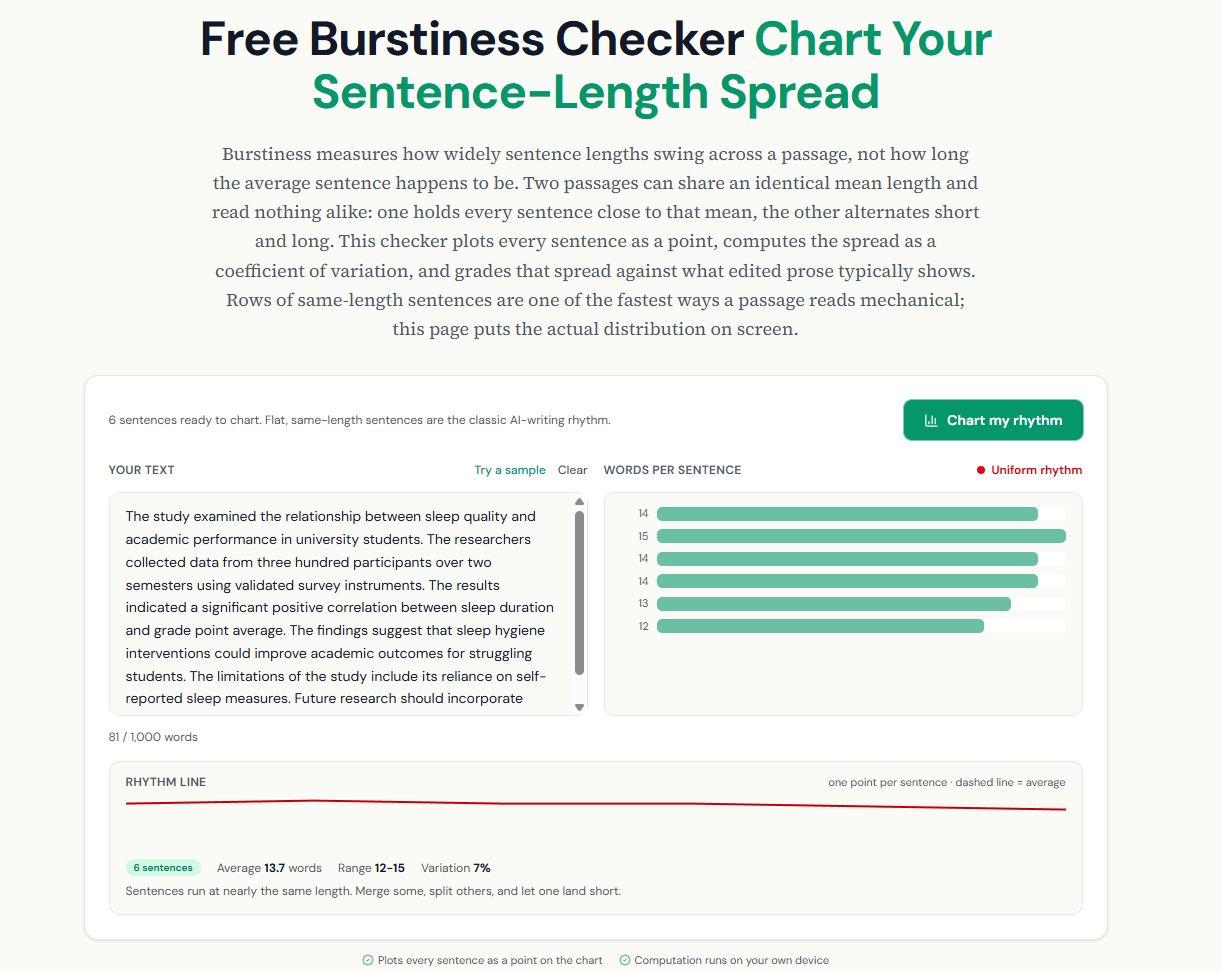
The arithmetic is short. Count the words in every sentence, take the standard deviation of that list, then divide by the mean. For instance, if you look at a passage with sentences that are eight, thirty-one, eleven, twenty-four and nine words long, you get a spread of around fifty-six percent of the mean, a wide burst. If you look at a passage with sentences that are fifteen, sixteen, fourteen, seventeen and fifteen words long, you get a spread of about seven percent, even though the two passages average almost the same length.
A raw standard deviation on its own would not do the same job. Eight words of spread means something different in a passage averaging twelve words per sentence than in one averaging forty, so dividing by the mean is what makes the number comparable from one passage to the next.
That relative framing is why the statistic works the same way for a clipped news style and a dense theoretical one. A technical section built from short, uniform sentences and a casual paragraph built from short, uniform sentences can both register as low burstiness, because the measurement never asks how long a sentence is in absolute terms, only how far each one sits from its neighbours' average.
This is the identical calculation the free burstiness checker on this site runs against a pasted draft, charting every sentence as a point rather than compressing the whole passage into one figure. On that scale, anything under roughly twenty percent reads as a tight, uniform spread, and anything above roughly forty five percent reads as a wide one, with most edited academic prose landing somewhere in between.
What a low-variance paragraph looks like on the page
Put the two patterns side by side and they are easy to tell apart once you know what to look for.
| Trait | Low-variance paragraph | High-variance paragraph |
|---|---|---|
| Sentence length pattern | Nearly every sentence sits within a few words of the paragraph's average | Short, clipped sentences sit beside long, multi-clause ones |
| Reading it aloud | A steady, even pace with no natural place to pause for emphasis | A rhythm that speeds up and slows down, tracking where the emphasis actually falls |
| Typical cause | Unedited output from a model predicting one likely next sentence at a time, or a first draft nobody has read back aloud | A writer cutting a sentence short for effect, or folding two thin sentences into one that earns its length |
Neither column is inherently good writing. A methods section listing five steps in five short sentences is supposed to look like the left column, and a long, winding sentence dropped into a numbered procedure would not improve it. The pattern only becomes informative once you know what kind of passage is being looked at.
Why uniform sentences get flagged
Detectors treat a flat rhythm as a signal because of how text generation works, not because uniform sentences are inherently suspicious on their own. The broader mechanics of how AI detectors actually work are covered separately; the short version is that a model predicts one token at a time, including, implicitly, when a sentence is likely to end. Given the text so far, some sentence length is statistically more probable than the rest at any given moment, and a model that keeps choosing the most probable continuation keeps landing near that same likely length, sentence after sentence, across an entire document.
A single flat paragraph proves nothing on its own; short procedural sections are supposed to look like that. What a detector is actually weighing is the pattern across an entire document: whether the flatness in one paragraph is a local, purposeful choice, or the rhythm of every paragraph in the piece.
Word-by-word predictability is a related but separate measurement, covered on its own terms elsewhere on this site, and it looks at individual word choices rather than the shape of a sentence.
None of this proves a document was generated by a model, and treating a flat rhythm as decisive on its own would repeat the same mistake as treating a single perplexity number as decisive. A rushed first draft nobody has read aloud can flatten just as easily as generated text can. That is part of why TextPulse's own estimated Human Score combines sentence-level variation with several other signals rather than resting on any one of them, and why the free diagnostic tools on this site are built to be read together rather than in isolation.
Two follow-up questions matter more than the definition. Whether detectors still weight burstiness the way they did in 2023 is one, and how to raise it in your own drafts without wrecking the prose is the other.
A flat paragraph is not a mystery once the mechanism behind it is visible. It is what happens when every sentence gets built the same way a single next word does, by reaching for whatever comes next with the least resistance. Whether that pressure wins depends on the writer, or the model, pushing back against it sentence by sentence.
Related research: the findings above are examined at scale in Sentence-Length Burstiness as a Signal of AI Rewriting, a TextPulse Research working paper with open data, code and a citable DOI. Whether prompting alone can make a model write like a person is tested in Do AI Models Speak Human?.
Frequently Asked Questions
What is burstiness in writing? It is the amount that sentence length varies across a passage, measured as the standard deviation of sentence lengths divided by their mean. A passage with wide swings between short and long sentences has high burstiness. A passage where every sentence sits close to the same length has low burstiness, whether that length is short or long.
PhD in natural language processing, with years spent building NLP applications end to end. Moe works on text analysis: lexical and syntactic structure, and what separates machine-generated prose from human prose statistically. He has been experimenting with computational linguistics since the early days of NLTK, spaCy and WordNet, and still writes most of his tooling in Python.