How to Raise Perplexity and Burstiness in Your Writing
Raising perplexity and burstiness on purpose usually just means writing better: varying sentence length, mixing clause structures, and choosing the word that actually fits instead of the one that merely scans. Concrete before-and-after examples, plus where this stops being craft and starts being a bad idea.
Search how to increase burstiness and most results promise a shortcut: a synonym swap, a random long sentence dropped in, maybe a broken rule of grammar for good measure. None of that is what actually moves the number. Raising perplexity and burstiness in a piece of writing is mostly a matter of sentence architecture, the same craft a careful editor already practices, applied on purpose instead of by habit.
This is a practical piece, not a mechanism explainer. The formula behind burstiness, and where the term actually came from, is covered in the companion piece on what burstiness actually measures; perplexity has its own companion post doing the same job. What follows here is technique: specific ways of building a sentence that carry more of both measures, with before-and-after examples, plus an honest account of where this stops being writing advice and starts being a bad idea.
How to Increase Burstiness by Varying Sentence Length on Purpose
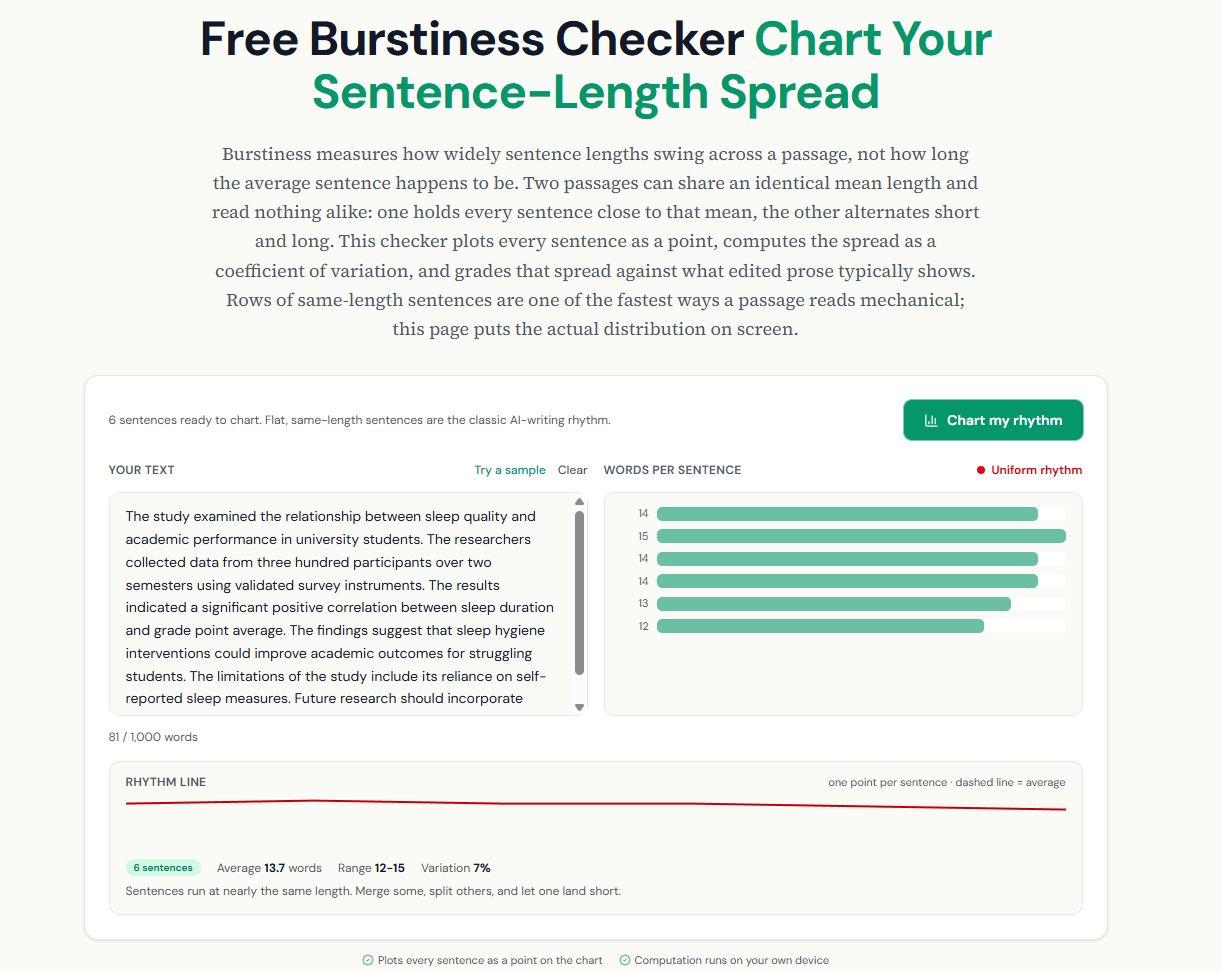
Burstiness tracks the spread between your sentences, not their average length, so the fastest lever is deliberately widening that spread instead of drifting into one comfortable length for an entire paragraph. Most first drafts settle into a rhythm nobody chose on purpose: three sentences in the twelve-to-sixteen-word range feel safe, so a fourth and fifth follow the same pattern without anyone deciding they should.
Before: 'The sample size limited statistical power. The results should be interpreted with caution. Future research should address this limitation with larger cohorts.' Three sentences, eight to eleven words each, one register throughout. After: 'The sample was little, which limited statistical power in ways worth saying plainly rather than hedging around. That matters. A single larger cohort could shift the effect size enough to change which claims the paper is entitled to make.' Same content, a completely different spread.
The target is not maximum variety at all costs. A paragraph alternating a forty-word sentence with a two-word sentence on every single line reads as a tic rather than a rhythm. The aim is closer to how a person naturally paces an explanation out loud: a longer run-up sentence when an idea needs the room, a short one when it does not.
Mix Clause Structures Instead of Repeating One
A paragraph can vary its word counts and still feel flat if every sentence is built the same way: subject, verb, object, full stop, repeat. Burstiness responds to structural variety as much as to length, because a reader, or a model predicting the next likely construction, gets thrown off by a sentence that opens with a subordinate clause, or a question, after several sentences that opened with the subject.
Before: 'The intervention reduced anxiety scores. The effect held across age groups. The mechanism remains unclear.' Three subject-first sentences in a row. After: 'Anxiety scores dropped after the intervention. Whether that held across every age group took a second look to confirm, and it did. What is still missing is a mechanism that explains why.' Nothing about the underlying finding changed between those two versions, only the architecture the reader has to move through to reach it.
This is not complexity for its own sake. A subordinate clause up front earns its place when it genuinely sets up the sentence that follows: a time marker, a condition, a concession. Bolted on for variety alone with nothing to justify it, the same construction reads exactly like what it is, decoration rather than architecture.
Choose the Specific Word Over the Expected One
Perplexity moves at the word level, so the sentence-length work above only carries half the load. A model assigns high probability to the generic next word: significant, notable, important, whatever a thousand other papers in the same genre would reach for at that spot. Naming the actual number, the actual mechanism, or the actual objection a reviewer raised costs the model far more surprise than the word that was merely safe.
Before: 'The findings were major and have important implications for the field.' A sentence built from the words a reviewer expects, in the order a reviewer expects them. After: 'Three of four cohorts cleared the threshold; the fourth missed it by two points, which the discussion section never explains.' The second version could only describe this particular study. The first could sit at the end of almost any paper in any discipline.
This doesn't mean padding a sentence with unnecessary detail. It means keeping the detail that was already true and specific, rather than smoothing it into the generic phrase a first draft reaches for under deadline. A precise number, a named limitation, a particular counterexample cost more to generate because they are less predictable, and they also happen to be better sentences.
Let a Short Sentence Land After a Long One
The previous two techniques work sentence by sentence. This one is about what a sentence does relative to its neighbor. A long sentence, one that stacks a subordinate clause onto a qualification onto a specific detail, creates an opening. Following it immediately with something short breaks the rhythm a reader, and a classifier, would otherwise settle into.
Before: 'The treatment group showed improvement across three of the four measures tracked, and while the fourth measure didn't reach statistical significance, the trend was directionally consistent with the other three, suggesting the null result there may reflect a power issue rather than a true absence of effect, a possibility the original protocol didn't expect.' One sentence carrying five ideas. After: 'The treatment group improved on three of four measures. The fourth didn't reach significance, though the trend pointed the same way. That gap was not in the original protocol.' The long version and the short version end up saying almost the same thing, but only one of them gives the reader anywhere to breathe.
One short sentence per paragraph earns its keep. Several in a row start to feel like a tic borrowed from advertising copy, three words at a time, which is its own kind of uniformity and can flatten a paragraph just as effectively as never varying at all.
Not every technique above pulls on the same lever. Some move perplexity more, some move burstiness more, and a few move both at once.
| Technique | Moves mainly | Why |
|---|---|---|
| Varying sentence length | Burstiness | Widens the gap between the shortest and longest sentence, which is what the spread-based measure tracks |
| Mixing clause structures | Both | Breaks the expectation of a fixed pattern from one sentence to the next |
| Choosing the specific word | Perplexity | A named detail costs a model more surprise than a generic placeholder would |
| A short sentence after a long one | Burstiness | Creates the sharp contrast the variance calculation is built to catch |
Humanize your own paper
Transform your AI-assisted text and make it sound human, without touching important words or citations.
Why Academic Prose Flattens Out
Several ordinary habits push academic sentences toward the same length, and none of them are laziness. Hedging is one: phrases like "it could be argued that" or "the findings appear to suggest" add a near-identical clause to the front of sentence after sentence, so what follows inherits a similar shape before the actual content even starts. A second is the topic-sentence template drilled into most writers early on: one claim, then a run of supporting sentences built to roughly the same length.
A third cause runs deeper than habit. Revision that smooths a draft until it sounds uniformly formal can strip out exactly the length variation an earlier, rougher draft still had, since choppy and uneven is often the first thing a writer edits away when polishing for tone. The result reads as careful. It also reads as flat, and the two are not the same compliment.
What Rhythm Actually Does for a Reader
A short sentence carries more weight directly after several long ones, and the effect is almost entirely a matter of contrast rather than content. Three sentences of thirty words each build an expectation for a fourth. A five-word sentence breaking that expectation reads as deliberate, almost as if the writer paused, and a reader registers the pause as emphasis without needing to say why.
The reverse cost is just as real and gets far less attention. A paper that runs close to twenty-eight words a sentence for six pages straight is not difficult to read once. It is difficult to read for six pages, because nothing in the rhythm signals where one idea ends and the next begins, and a reader has to supply that structure alone, sentence after sentence, for the length of the whole chapter. Fatigue like that has little to do with vocabulary or argument quality. It is a pacing problem.
Before and After: Two Flat Paragraphs, Rewritten
Two short passages make the mechanism concrete. Neither example changes what is being claimed, only how the claim is paced.
| Before | After | What changed |
|---|---|---|
| The intervention reduced anxiety scores across all three cohorts, and this reduction was consistent regardless of age, which was not anticipated at the outset of the study and suggests the mechanism may not be age-dependent, a possibility the original hypothesis did not account for. | The intervention reduced anxiety scores across all three cohorts. That held regardless of age, which nobody on the team expected going in. The mechanism may not be age-dependent after all. | One sixty-word sentence became three sentences of different lengths. The claim did not change. The pacing gives a reader three separate places to register what happened. |
| Participants were recruited from four clinics. Ethical approval was obtained in advance. Consent was documented in writing. Data collection ran for six months. Analysis followed a pre-registered plan. | Participants were recruited from four clinics, with ethical approval obtained in advance and consent documented in writing before data collection began, which then ran for six months under a pre-registered analysis plan. | Five uniform sentences became two longer ones. This runs opposite to the first example: procedural steps artificially chopped into a checklist read more naturally combined, since they describe one continuous process rather than five separate events. |
Where Uniformity Is Still the Right Choice
None of this is a rule to apply everywhere without judgment. A numbered methods section listing five sequential steps is supposed to read like five short, similar instructions, because the reader needs to execute them in order, not admire the prose while doing it. A checklist in an appendix or a set of interview questions reproduced verbatim earns its uniformity, and no rewrite should manufacture variation where none is needed.
None of this needs special software to notice, only a willingness to read a page back at the pace a reader actually will. TextPulse's free tools collection covers the rhythm, vocabulary and structure checks worth running across a full draft, not just one paragraph at a time.
Rhythm is only part of what a classifier reads. The fuller account of why AI text gets flagged covers everything else, and Turnitin's own method is described separately for anyone whose deadline runs through that particular system.
The same flatness that tires a reader is also, mechanically, most of what a detector is measuring when it reports low variation across a document, a subject this site's pillar guide to how AI detectors actually work covers on its own terms. A reader gets there first either way. The rhythm was always the reader's problem before it became a statistic.
Writing to Be Read, Not to Beat a Score
Every technique above is also just good editing. Varying sentence length, mixing clause structures, naming the specific detail rather than the safe generalization: an editor with no interest in AI detection would make the same changes for the same reason, because the result reads better. That overlap is not a coincidence. A careful reader and a perplexity calculation are responding to the same property of the writing, how much of it is doing real work rather than filling space with the expected phrase.
The overlap breaks down the moment the goal flips from writing well to beating a number. A sentence lengthened for no reason other than raising an average, a construction made clunky on purpose, a word chosen for rarity rather than for rightness: all of it raises a score and makes the writing worse, a bad trade even before considering how it reads to whoever is actually grading or reviewing it. A detector is also never the only reader in the room, and prose written to satisfy one statistic tends to satisfy nobody else.
TextPulse's own free perplexity checker and free burstiness checker are built for exactly this kind of self-check: paste a draft, see where it sits, and decide whether a flat stretch is a stylistic problem worth revising rather than a guess. The rest of TextPulse's free tools collection covers the other layers of the same question, word choice, structure, tone, for a fuller read than either measure gives alone.
The same technique, described without the metric attached, is simply varying sentence length in academic writing. It is worth pairing with the wider question of why AI text gets detected at all, so the edits stay aimed at the cause.
None of this requires believing a single number tells the whole truth about a piece of writing, which is worth remembering given how these measures fit into the fuller account of how AI detectors actually work. A paragraph that reads well out loud, with room to breathe and at least one sentence that could only have been written by someone who knows the material, tends to take care of the rest on its own.
Related research: the findings above are examined at scale in Sentence-Length Burstiness as a Signal of AI Rewriting, a TextPulse Research working paper with open data, code and a citable DOI. Whether prompting alone can make a model write like a person is tested in Do AI Models Speak Human?.
Frequently Asked Questions
How to increase burstiness comes down to widening the gap between your shortest and longest sentence rather than letting every sentence settle near the same length. A paragraph built from three twelve-word sentences in a row has almost no spread. Breaking that pattern with one short sentence and one longer, more detailed sentence raises the measure immediately, and it usually reads better too.
PhD in natural language processing, with years spent building NLP applications end to end. Moe works on text analysis: lexical and syntactic structure, and what separates machine-generated prose from human prose statistically. He has been experimenting with computational linguistics since the early days of NLTK, spaCy and WordNet, and still writes most of his tooling in Python.